Profile
Red Schoendienst
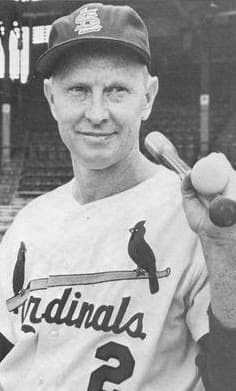
Red Schoendienst with the St. Louis Cardinals, 1965.
Photo credit: Unknown author via Wikimedia Commons (Public domain)
Albert Fred Schoendienst grew up in Germantown, Illinois, a village of 800 people where his mother Mary stuffed sawdust into coverings to make baseballs for her children because they couldn't afford real ones. Schoendienst batted .289 with 2,449 hits across 19 seasons, earned 10 All-Star selections, led NL second basemen in fielding percentage six times, managed the Cardinals to the 1967 World Series championship, survived tuberculosis that nearly ended his career in 1958, and spent 74 consecutive years in a major league uniform as player, coach, manager, and special assistant, hitting fungoes to infielders during pregame practice well into his 90s. Stan Musial, his roommate and closest friend, said, "They don't come any better." Hank Aaron, who played alongside Schoendienst in Milwaukee, described what his acquisition did to the Braves clubhouse. "It made us all feel like Superman." The Veterans Committee elected Schoendienst to the Hall of Fame in 1989. "I never thought that milk truck ride would eventually lead to Cooperstown and baseball's highest honor," Schoendienst said in his induction speech, recalling the hitchhike that carried him to his first Cardinals tryout.
Germantown
Schoendienst was born on February 2, 1923, in Germantown, 40 miles east of St. Louis. His father Joe worked 50 years in the coal mines and caught for the Clinton County League, and three of Red's five brothers played minor league ball. Schoendienst never attended a major league game before playing in one. He joined the Civilian Conservation Corps at 16, earning a dollar a day planting trees and maintaining roads, until a staple ricocheted from a coworker's hammer into his left eye. The pain was the worst he experienced in his life, and doctors recommended removing the eye. Schoendienst refused, found one doctor willing to try exercises, and gradually recovered partial vision over months of rehabilitation. The damaged eye made it difficult to pick up breaking balls from right-handed pitchers when he batted from the right side, so he became a switch hitter, turning a disability into the foundation of a career that lasted nearly two decades.
Schoendienst served in the Army during the Second World War, suffered a shoulder injury from weapon recoil at Pine Camp in New York, and received a medical discharge on January 1, 1945. He debuted with the Cardinals on April 17, 1945, starting in left field while Musial served in the Navy, tripled in his first game, and moved to second base the following year when Lou Klein jumped to the Mexican League. The Cardinals won the 1946 World Series over the Red Sox, and Schoendienst anchored second base in St. Louis for the next decade. He set an NL record with a .9934 fielding percentage in 1956, a mark that stood 30 years until Ryne Sandberg broke it, and he once handled 320 consecutive chances without an error in 1950. He peaked offensively in 1953 with a .342 average and 107 runs scored, losing the batting title by two points to Carl Furillo of Brooklyn, who broke his hand late in the season.
Milwaukee and the Diagnosis
The Cardinals traded Schoendienst to the New York Giants in June 1956 in an eight-player deal, and Musial called it his "saddest day in baseball." Milwaukee acquired him from the Giants the following year, and Schoendienst led the league with 200 hits, finished third in MVP voting, and helped the Braves defeat the Yankees in the 1957 World Series, the franchise's first championship since 1914.
The 1958 World Series exposed something nobody understood at the time. Schoendienst couldn't move on the field, couldn't react to the ball, couldn't swing the bat with any force. "When I was in the field, I couldn't move," he said. "When I walked up to bat, I could hardly swing the bat. I saw the ball well, but I couldn't react to it." After the Series, doctors diagnosed tuberculosis. Schoendienst spent months at Mount Saint Rose Sanatorium in St. Louis and underwent a partial lung removal in February 1959 to speed the recovery. President Eisenhower wrote him a letter. "Anyone with the competitive spirit that you have so often demonstrated can lick this thing." He received more than 10,000 letters during his stay. Doctors said he would never play again. Schoendienst came back in September 1959 for three at bats and received an 18,000-fan ovation at Milwaukee County Stadium. "I'm just the same as anybody else now," he said. "To get TB again, I'd have to go out and catch a whole new case of it."
The Manager
Schoendienst returned to the Cardinals in 1961, became a player-coach, and took over as manager in 1965 after Johnny Keane resigned. In 1967 the Cardinals went 101-60, won the pennant by 10 and a half games, and defeated the Red Sox in a seven-game World Series in which Bob Gibson won three games and Lou Brock batted .414. Schoendienst managed the Cardinals for 12 full seasons through 1976, the longest tenure in franchise history until Tony La Russa surpassed him, and compiled a 1,041-955 record. He won five World Series across his career as player, coach, and manager, all five decided in seven games.
Schoendienst hit the All-Star Game's first extra-inning home run in 1950, a 14th-inning blast at Comiskey Park that he predicted to his teammates before stepping to the plate. His final at bat came on July 7, 1963, in San Francisco, 18 years after his first. Whitey Herzog, who grew up in New Athens, Illinois, less than 40 miles from Germantown, and managed the Cardinals with Schoendienst on his coaching staff, said at the funeral, "He'll be remembered not only for what a great ballplayer he was, but what a great person he was." Schoendienst died on June 6, 2018, at his home in Town and Country, Missouri, at 95, the oldest living Hall of Famer and the last surviving member of the 1946 World Series championship team.