Profile
Tony Lazzeri
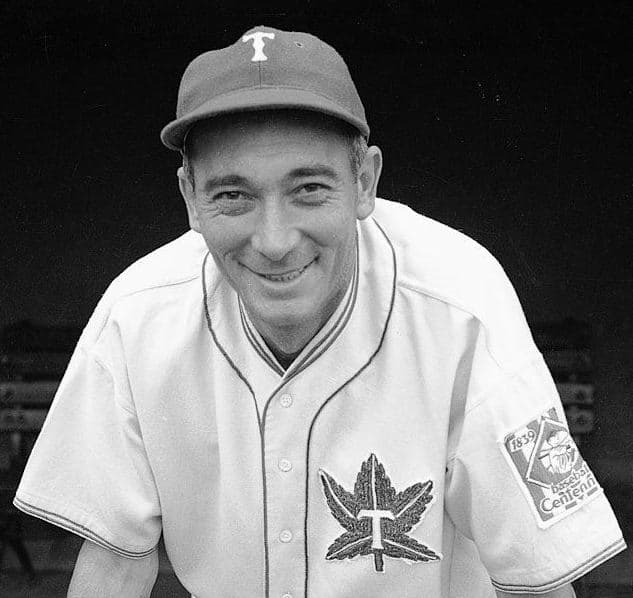
Tony Lazzeri portrait.
Photo credit: Lou or Nat Turofsky via Wikimedia Commons (Public domain)
Anthony Michael Lazzeri was inducted into the Hall of Fame in 1991, 45 years after he died alone in his house in Millbrae, California. For 53 years before that plaque was hung, his name already appeared in Cooperstown, but only on somebody else's. Grover Cleveland Alexander's plaque, hung in 1938, reads, "Won 1926 World Championship for Cardinals by striking out Tony Lazzeri with bases full in final crisis at Yankee Stadium." Lazzeri played 12 seasons for the Yankees alongside Babe Ruth and Lou Gehrig, batted .292 with 178 home runs and 1,194 RBI, drove in 100 runs seven times, won five World Series championships, and became the first player in major league history to hit two grand slams in a single game. But the strikeout in the seventh inning of Game 7 of the 1926 World Series, one pitch from being a grand slam that would have changed the game and the narrative entirely, followed him for the rest of his life and beyond it. Red Smith, the sportswriter, wrote after Lazzeri's death, "It was Lazzeri's misfortune that although he was as great a ball player as ever lived, the most vivid memory he left in most minds concerned the day he failed."
San Francisco
Lazzeri was born on December 6, 1903, in the Cow Hollow district of San Francisco to Augustine and Julia Lazzeri, Italian immigrants. His father worked as a boilermaker earning $4.50 a day, and Lazzeri was expelled from school at 15, went to work alongside his father at Maine Iron Works, and trained as a prizefighter before professional baseball found him. He signed with the Salt Lake City Bees of the Pacific Coast League and in 1925, at 21, produced a season that remains one of the most extraordinary in the history of professional baseball. He hit 60 home runs with 222 RBI, 252 hits, 202 runs scored, and 39 stolen bases across 192 games, the most home runs any professional player had struck in a single season at that time.
Lazzeri lived with epilepsy throughout his life, a condition known only to scouts, team management, and a small circle of confidants. Multiple teams passed on acquiring him because of it. The Chicago Cubs and the Cincinnati Reds both declined. Ed Barrow, the Yankees' general manager, responded to the concern with a sentence that settled the matter. "As long as he doesn't take fits between three and six in the afternoon, that's good enough for me." The Yankees took out an insurance policy, paid $50,000 to Salt Lake City, and brought Lazzeri to New York.
Murderers' Row
Lazzeri debuted with the Yankees in 1926, and in Game 7 of the World Series against the Cardinals that October, with the bases loaded and two outs in the seventh inning, 39-year-old Grover Cleveland Alexander came out of the bullpen after having pitched a complete game the day before. Lazzeri fouled a pitch down the left field line that missed being a grand slam by roughly 10 feet. Alexander then struck him out on a curve, low and away. The Cardinals held on to win the championship.
The at bat defined Lazzeri's public legacy, but his career dwarfed it. In 1927 he hit .309 with 18 home runs and 102 RBI on the Murderers' Row team that went 110-44 and swept Pittsburgh in the World Series, and Miller Huggins called him the "brains" of the Yankee infield. On May 24, 1936, at Shibe Park in Philadelphia, Lazzeri hit two grand slams in a single game (off George Turbeville in the second inning and Herman Fink in the fifth), added a solo home run in the seventh, finished with 11 RBI, and set the American League single-game record that still stands. He also hit for the natural cycle on June 3, 1932, the only player in history to complete the natural cycle with a grand slam.
Lazzeri won six pennants and five championships with the Yankees (1927, 1928, 1932, 1936, 1937) and was deeply popular with the Italian-American community in New York, who adopted the rallying cry "Poosh 'em up, Tony!" that originated when an Italian-speaking fan in Salt Lake City shouted it during a game in 1925. Frankie Crosetti, his teammate, said, "Tony not only was a great ballplayer, he was a great man. He was a leader. He was like a manager on the field." A reporter who tried to get Lazzeri to talk described the experience as "like mining coal with a nail file."
Millbrae
The Yankees released Lazzeri after the 1937 season, and he cycled through the Cubs, Dodgers, and Giants across the next two years without finding a permanent home. He managed in the minor leagues through 1943, owned a tavern in San Francisco, and gave one of his last interviews to columnist Bob Considine in 1945. "Funny thing," Lazzeri said, "but nobody seems to remember much about my ball playing, except that strikeout. There isn't a night goes by but what some guy leans across the bar or comes up behind me at a table in this joint, and brings up the old question. Never a night." He also said, "Around New York I used to hear that expression, 'Once a Dodger, always a Dodger.' But how about, 'Once a Yankee, always a Yankee?' There never was anything better than that. You never get over it."
On August 6, 1946, Lazzeri's wife found him slumped on the landing of their home in Millbrae. He was 42. The coroner ruled a heart attack, but many historians believe an epileptic seizure caused the fall. He died alone, one year after telling Considine that the strikeout question followed him every night, and 45 years before the Veterans Committee gave him a plaque of his own.