Profile
Arky Vaughan
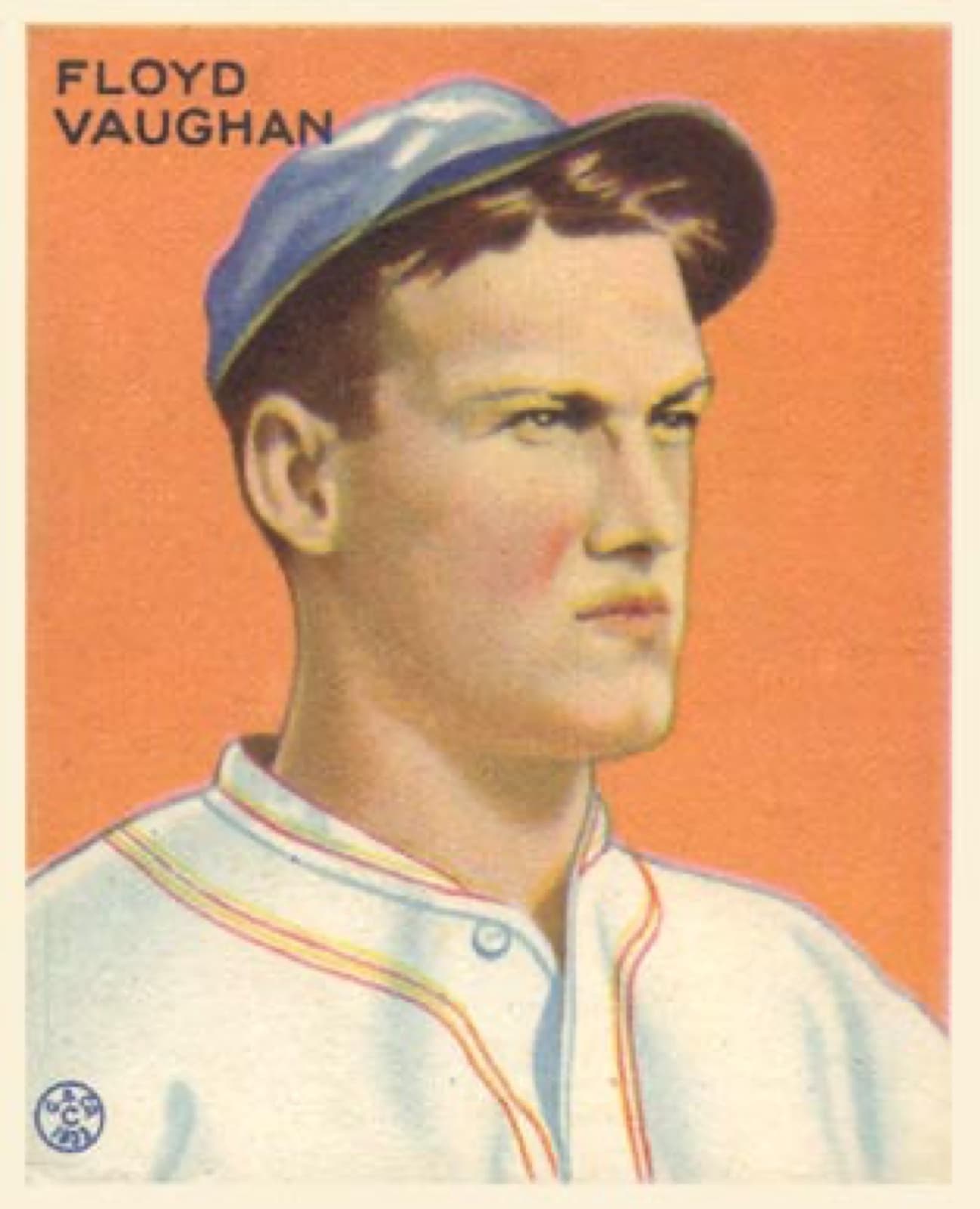
Arky Vaughan portrait from Goudey card issue.
Photo credit: Goudey via Wikimedia Commons (Public domain)
Joseph Floyd Vaughan got the nickname "Arky" from childhood friends in California who knew he was born in Arkansas, and the name stuck even though he left the state as an infant. Vaughan batted .318 with a .406 on-base percentage across 14 seasons for the Pittsburgh Pirates and Brooklyn Dodgers, hit .300 or better in each of his first 10 major league years, and produced a 1935 season (.385, .491 on-base percentage, 1.098 OPS) that remains the highest batting average by a National League shortstop in the twentieth century. Honus Wagner, who coached at Pittsburgh and mentored Vaughan as a young Pirate, said, "Of all the players I tried to help, he's the best and the one that went the farthest." Joe Posnanski called him "the least-known great Major League Baseball player." Vaughan drowned at 40 while trying to save a friend in a California lake, and 33 years after his death the Veterans Committee elected him to the Hall of Fame in 1985.
Fullerton
Vaughan was born on March 9, 1912, in Clifty, Arkansas, but his parents Robert and Laura moved the family to California when he was seven months old, and he grew up in Fullerton, south of Los Angeles. At Fullerton High School he played football and baseball, and one of his schoolmates, Richard Nixon, later recalled him as "our star halfback, fast, hard-nosed and even then a real professional." Vaughan signed with the Pittsburgh Pirates' farm system in 1931, hit .338 with 21 home runs for Wichita, and debuted with Pittsburgh on April 17, 1932, at 20.
Wagner, then 58 and serving as a Pirates coach, took Vaughan under his wing. "One of the sweetest hitters I ever saw," Wagner said. "And fast!" Lloyd Waner confirmed the speed. "For going from home plate to second base I don't think there was anybody who could match him." Vaughan led the league with 19 triples in 1933 and hit for the cycle twice in his career (June 24, 1933, and July 19, 1939), going 5-for-5 both times.
1935
Vaughan's peak season produced numbers that no National League player matched for nearly 60 years. He batted .385 with 192 hits, 19 home runs, 99 RBI, 97 walks, and a .491 on-base percentage. The Sporting News named him Player of the Year, and Bill James later ranked him the second best shortstop in baseball history, behind only Wagner. The .385 average sat between Bill Terry's .401 in 1930 and Tony Gwynn's .394 in 1994 as the highest in the National League. Vaughan finished third in MVP voting that year behind Gabby Hartnett and Dizzy Dean, but his adjusted OPS of 190 ranks among the 100 greatest single seasons ever played.
On July 8, 1941, at Briggs Stadium in Detroit, Vaughan became the first player in history to hit two home runs in an All-Star Game, driving in four runs and giving the National League a 5-3 lead heading to the bottom of the ninth. Then Ted Williams hit a walk-off three-run homer with two outs on a 2-1 count to win it 7-5 for the American League, and the next morning's headlines belonged to Williams. Vaughan made nine consecutive All-Star teams from 1934 through 1942 and batted .364 in those games, but his greatest All-Star performance became a footnote.
The Walkout
The Pirates traded Vaughan to Brooklyn after the 1941 season, and in July 1943 manager Leo Durocher suspended pitcher Bobo Newsom for insubordination, then publicly accused Newsom of throwing illegal spitballs. Vaughan confronted Durocher in front of the team. According to teammate Billy Herman, Vaughan stripped off his uniform and told Durocher where to put it. Most teammates initially sided with Vaughan and threatened not to play, but Durocher and GM Branch Rickey persuaded everyone except Vaughan to take the field. Vaughan returned to uniform before the game ended and finished the 1943 season, batting .305 in 149 games and leading the league in runs scored and stolen bases, but he walked away from baseball after the final game, returning to his California ranch for three full years.
When Commissioner Happy Chandler suspended Durocher for the 1947 season, Vaughan came back to Brooklyn at 35 and hit .325 in 64 games as a part-time player. Jackie Robinson later said Vaughan "was one of the fellows who went out of his way to be nice to me when I came in here as a rookie. Believe me, I needed it." Vaughan appeared in three games of the 1947 World Series as a pinch hitter, walked once and doubled, and hit .244 in a part-time role in 1948 before the Dodgers released him.
Lost Lake
On August 30, 1952, Vaughan and a friend named Bill Wimer were fishing from a small skiff on Lost Lake, a volcanic crater lake near Eagleville in northern California. Wimer, who reportedly could not swim, stood up in the boat, and the skiff capsized. Both men swam roughly 65 yards but sank in about 20 feet of water, just 20 feet from shore. Witnesses said Vaughan had turned back to try to help Wimer. Their bodies were recovered the following morning. Vaughan was 40 years old. Pee Wee Reese said, "A steady, easy-going guy, and he had a good long life to look forward to." Warren Giles, the National League president, called him "a gentleman and a fine competitor."
Nixon sent a letter for Vaughan's Hall of Fame induction in 1985, remembering his high school classmate and noting that Vaughan's .385 was "a 20th-century record for National League shortstops." The BBWAA had never given Vaughan more than 29 percent of the vote during his years on the regular ballot, and the Veterans Committee's election came 33 years after his drowning. Vaughan walked 937 times and struck out only 276, a 3.4-to-1 ratio that reflects a discipline at the plate as quiet and efficient as the man himself.