Profile
Bucky Harris
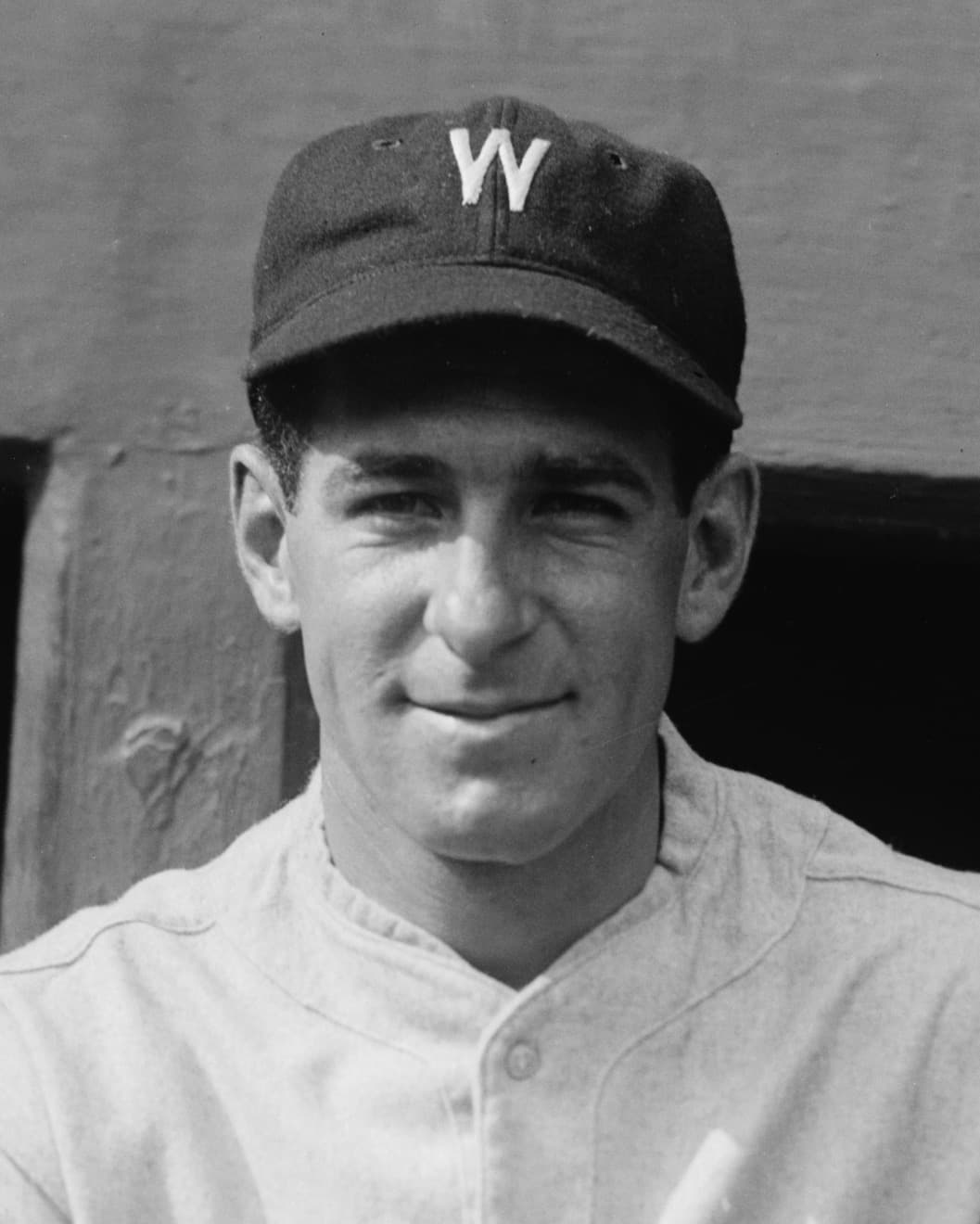
Bucky Harris portrait.
Photo credit: Bain News Service via Wikimedia Commons (Public domain)
Stanley Raymond Harris quit school at 13 to work in a Pennsylvania coal mine, managed the Washington Senators to a World Series championship at 27, won another with the Yankees 23 years later, and spent the years between managing five different teams across 29 seasons while earning a reputation as the most patient man in a profession that rewards impatience. He died on his 81st birthday. Joe DiMaggio said, "If you can't play for Bucky, you don't belong in the major leagues."
Hughestown
Harris was born on November 8, 1896, in Port Jervis, New York, to Thomas Harris, a Welsh immigrant who worked as a coal miner, railroad detective, and police officer, and Catherine Rupp Harris, of Hughestown, Pennsylvania. The family moved to Pittston, a coal town in northeastern Pennsylvania, when Bucky was young. At 13 he quit school to work at the Butler Mine as an office boy, earning $9.72 a week as weighmaster by age 14. He played semipro baseball in the Suburban League for $2 a game and basketball with enough aggression that the nickname "Bucky" stuck from the way he shook off defenders.
His older brother Merle played minor league second base. Senators scout Joe Engel discovered Bucky in the minors and brought him to Washington, where he debuted on August 28, 1919. In his first major league game he singled off Carl Mays and drove in two runs, then broke his hand in three places.
The Boy Wonder
Harris established himself as Washington's starting second baseman in 1920, batting .300 with 152 hits, and held the job for the next eight years. He led American League second basemen in double plays five consecutive years from 1921 through 1925 and was hit by pitches more than any player in the league three years running. He played with intensity rather than elegance, standing five-nine and 156 pounds, and his strength was positioning and toughness rather than range or arm.
After the 1923 season, when Harris was 27, Senators owner Clark Griffith named him player-manager. The appointment stunned the baseball establishment, and when the Senators won the 1924 American League pennant, Harris became the youngest manager to reach the World Series.
The opponent was John McGraw's New York Giants. The Series went seven games, and Harris played a starring role on both sides of the ball, batting .333 with two home runs and seven RBI while setting Fall Classic records for a second baseman in chances accepted, double plays, and putouts. His strategic gamble in Game 7 drew the most attention. He started right-hander Curly Ogden, who faced only two batters, then brought in left-hander George Mogridge. The move eventually forced McGraw to pinch-hit right-handed Irish Meusel for left-handed-hitting Bill Terry in the sixth inning. What happened next has been retold for a century. In the bottom of the eighth, with Washington trailing 3-1, Harris hit a routine grounder to third base. The ball struck a pebble and took a bad hop over Freddie Lindstrom's head, scoring two runs to tie the game. Harris called on Walter Johnson, who had lost Games 1 and 5, and Johnson held the Giants scoreless from the ninth through the twelfth. In the bottom of the twelfth, catcher Hank Gowdy stepped on his own discarded mask while attempting to catch a foul pop, extending the inning. Earl McNeely then hit another grounder toward Lindstrom at third. The ball again took a bad hop, reportedly off the same pebble, bouncing over Lindstrom's head and scoring Muddy Ruel with the run that gave Washington its only World Series championship. Both bad-hop grounders had victimized the same 18-year-old third baseman.
Harris led Washington to a second consecutive pennant in 1925, winning 96 games, but the Senators lost the World Series to Pittsburgh after holding a 3-1 series lead. Walter Johnson again started Game 7 and could not hold the lead in a rain-soaked contest. Harris managed the Senators through 1928, never finishing lower than fourth, before moving to the Detroit Tigers.
Five Teams
Harris managed the Tigers from 1929 through 1933, producing a winning record only once and never finishing above fifth. He spent 1934 with the Boston Red Sox, leaving after one season due to a feud with general manager Eddie Collins. He returned to Washington for a second stint from 1935 through 1942, producing one winning season in eight years. The Senators were not a good team, and Harris managed them anyway, because he loved Washington and Griffith trusted him.
The Philadelphia Phillies hired him in 1943 and fired him after 92 games. What happened next exposed the worst secret in Philadelphia's front office. Harris revealed that owner William D. Cox had been betting on Phillies games. Commissioner Kenesaw Mountain Landis banned Cox from baseball for life, and Cox was forced to sell the team.
Harris managed in the minor leagues during 1944 and 1945, then accepted the New York Yankees job for the 1947 season. The Yankees went 97-57, and Harris won his second World Series championship, defeating the Brooklyn Dodgers four games to three, 23 years after his first. Despite winning 94 games in 1948, Harris finished third behind Cleveland and Boston and was replaced by Casey Stengel.
He returned to Washington for a third time in 1950, managing through 1954. During this stint he signed Carlos Paula, the first black player in Senators history. He closed his managerial career with the Tigers again from 1955 through 1956, finishing fifth both years. He joked about his three Washington tenures: "Only Franklin D. Roosevelt had more terms than I did in Washington."
In 29 seasons he won 2,158 games, lost 2,219, and managed 4,410 games across eight separate stints with five different teams. At his retirement he ranked third in managerial wins behind Connie Mack and John McGraw. He won three pennants and two World Series championships and pioneered the use of a dedicated relief pitcher, making Firpo Marberry a closer before the concept had a name.
After the Game
Harris served as assistant general manager and then general manager of the Boston Red Sox from 1957 through 1960. During this period he promoted Pumpsie Green from the minor leagues on July 21, 1959, making the Red Sox the last of the original 16 teams to integrate, more than 12 years after Jackie Robinson. He scouted for the Chicago White Sox in 1961 and 1962 and spent his final decade as a special assistant with the expansion Washington Senators.
He married Mary Elizabeth Sutherland, daughter of former U.S. Senator Howard Sutherland of West Virginia, in 1926. They divorced in 1951. He married Marie, his second wife, who reportedly left him during his final illness.
Harris died on November 8, 1977, in Bethesda, Maryland. It was his 81st birthday. He had suffered from Parkinson's disease for years. He was buried in Hughestown, Pennsylvania, the coal town where he had worked in the mines as a boy. The Veterans Committee elected him to the Hall of Fame in 1975, recognizing a managing career that spanned more than three decades and produced championships separated by the longest gap in the game's history.