Profile
Gil Hodges
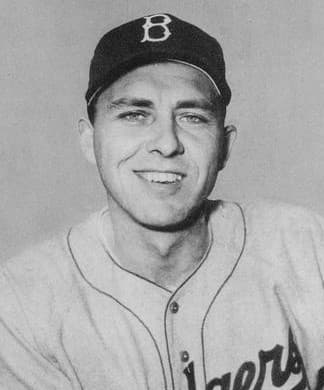
Gil Hodges in 1956.
Photo credit: Unknown photographer via Wikimedia Commons
Gil Hodges was the quiet strongman of the Brooklyn Dodgers, a slugger so gentle that the fans never booed him and so respected that they prayed for him when he slumped. He hit 370 home runs and anchored the Boys of Summer through their golden years, won a long-awaited title for Brooklyn, and then managed the most improbable champion in the game's history. He died young, at 47, with his Hall of Fame case still unsettled, and the recognition took half a century to arrive. The Golden Days Era Committee elected him to the Hall of Fame in 2022.
The Gentle Giant
Hodges was born on April 4, 1924, in Princeton, Indiana, and grew up strong and soft-spoken, the kind of man other players admired without quite being able to explain why. He served in the Marine Corps in the Second World War, fighting in the Pacific and earning a Bronze Star at Okinawa, and he came home to baseball with a steadiness that never left him. He was never once thrown out of a game for arguing, a remarkable fact for a star of his era, and his teammates spoke of him with something close to reverence. "If you had a son," Pee Wee Reese said, "it would be a great thing to have him grow up to be just like Gil Hodges."
Boys of Summer
For more than a decade Hodges was the cornerstone of the Brooklyn Dodgers, the powerful first baseman in a lineup of legends. He played alongside Jackie Robinson, Pee Wee Reese, Duke Snider, and Roy Campanella, the core that won pennant after pennant and broke Brooklyn's heart year after year against the Yankees. He hit for power and fielded his position better than anyone, winning three Gold Gloves once the award existed, the rare slugger who was also the best defender at his spot. On a team of stars, he was the quiet one in the middle of it all.
Power and a Prayer
Hodges put up enormous numbers for his time. He hit 370 home runs, a National League record for a right-handed hitter that stood until Willie Mays broke it, and he drove in more than 1,200 runs across his career while making eight All-Star teams. On August 31, 1950, he hit four home runs in a single game, one of only a handful of players ever to do it. The most famous moment of his struggles came when his bat went cold, and a Brooklyn priest, surveying his congregation, gave up on a sermon. "It's too hot for a sermon today," he said. "Go home, keep the commandments, and say a prayer for Gil Hodges."
The Brooklyn Title
The heartbreak finally ended in 1955. After losing World Series after World Series to the Yankees, the Dodgers beat them at last, and Hodges drove in both runs in the 2-0 Game 7 that gave Brooklyn the only championship it would ever win. He won another title in 1959 after the team moved to Los Angeles, hitting .391 in that World Series, a two-time champion who had outlasted the long years of falling short. The 0-for-21 he had suffered in the 1952 Series, the slump that drew the prayers, was behind him, and the borough that loved him finally had its crown.
The Miracle Mets
Hodges found a second act in the dugout that outshone even his playing days. After managing the Washington Senators, he took over the New York Mets, a franchise that had been a national joke since its birth, losing more games than any team in modern memory. In 1969 he led them to 100 wins and a World Series title, beating the heavily favored Orioles, the first expansion team ever to win it all and one of the greatest upsets in the history of sports. He had taken the worst team in baseball and made it a champion, and the achievement secured his place in the game's memory.
The Sudden End
The triumph did not last long. On April 2, 1972, two days before his 48th birthday, Hodges suffered a fatal heart attack during spring training in Florida, collapsing after a round of golf, his life cut off at the height of his managing career. The shock ran through the game, which had lost one of its most beloved figures with no warning, and the early death froze his record where it stood. He would never add to the case for Cooperstown, and the argument over whether he belonged would outlive him by 50 years.
The Fifty-Year Wait
Few players waited longer or came closer for longer. Hodges peaked at more than 63 percent on the writers' ballot in 1983, his final year of eligibility, agonizingly short of the line, and then the veterans committees passed him over for decades while the debate raged among fans who could not believe he was left out. The combination of the power, the defense, the championships, and the Miracle Mets eventually won the argument, and the Golden Days Era Committee elected him in December 2021. He went in wearing a Brooklyn cap, his number 14 long since retired by both the Mets and the Dodgers, the gentle giant honored at last.