Profile
Bobby Doerr
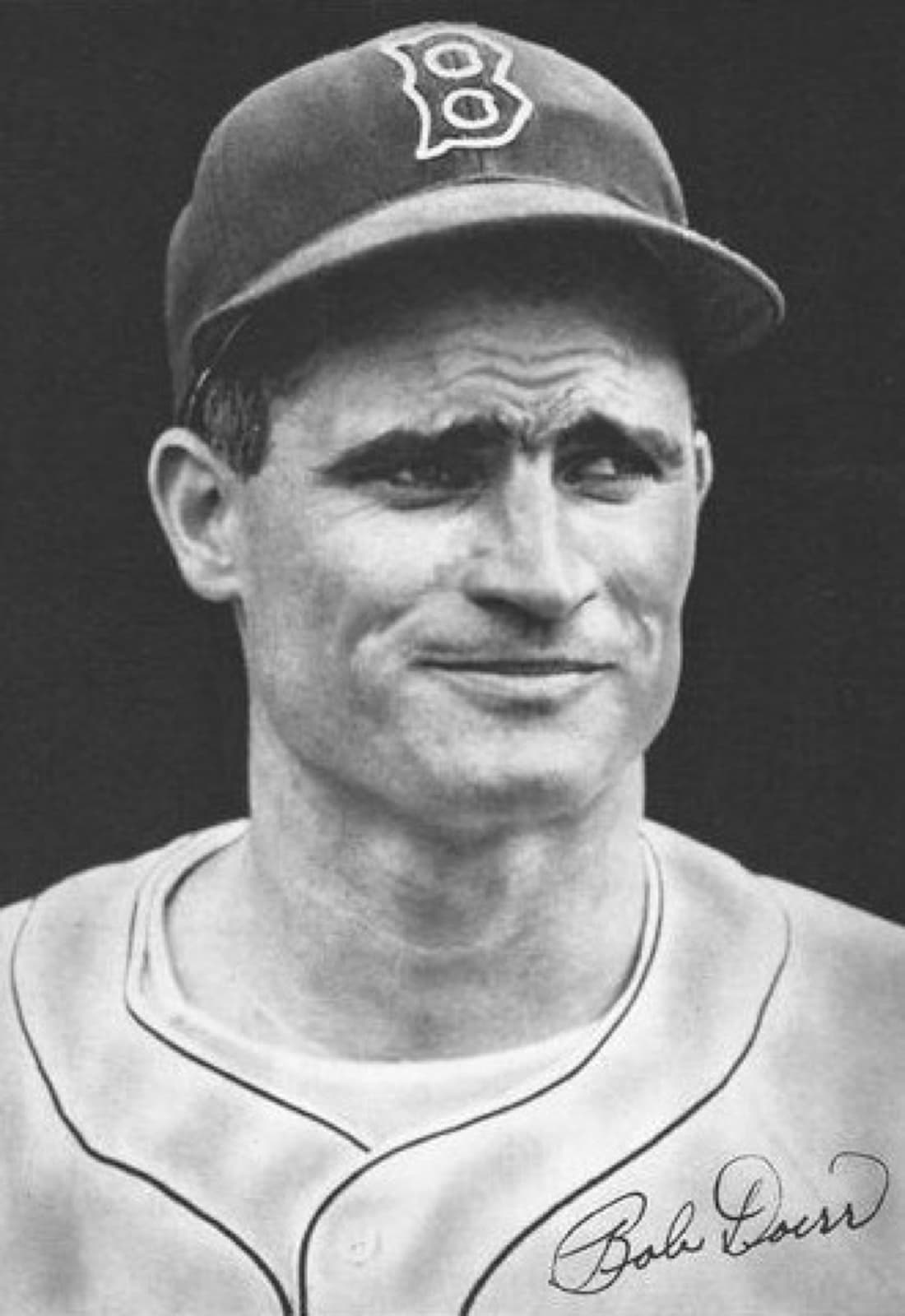
Bobby Doerr portrait, 1947.
Photo credit: Unknown author via Wikimedia Commons (Public domain)
Robert Pershing Doerr, named for the general who led American forces in the First World War, played 14 seasons at second base for the Boston Red Sox without ever wearing another uniform, made nine All-Star teams, hit .288 with 223 home runs and 1,247 RBI, drove in 100 or more runs six times, and served as the quiet center of a team that included the loudest personality in the game. Ted Williams called him "the silent captain of the Red Sox." Tommy Henrich of the Yankees said, "Bobby Doerr is one of the very few who played the game hard and retired with no enemies." Doerr's one regret was that the Red Sox never won a championship during his career, though they came agonizingly close three times. He lived to 99, the last surviving player who had faced Lou Gehrig, and the Veterans Committee elected him to the Hall of Fame in 1986.
Los Angeles
Doerr was born on April 7, 1918, in Los Angeles. His father Harold worked as a telephone company foreman, and his older brother Hal caught in the Pacific Coast League. Doerr signed with the Hollywood Sheiks of the PCL at 16 and was playing for San Diego by 1936 when Red Sox general manager Eddie Collins traveled west on a scouting trip. Collins watched Doerr play, purchased options on his contract and teammate George Myatt's for a reported $75,000, and on the same trip spotted a teenager on the San Diego Padres named Ted Williams. Doerr and Williams, both West Coast kids born two months apart, met in June 1936 and became lifelong friends. They fished together on the Rogue River in Oregon, argued about hitting, and stayed close for more than 60 years until Williams' death in 2002. Collins scouting one trip and finding two future Hall of Famers remains one of baseball's great talent identification stories.
Doerr debuted on April 20, 1937, at 19, going 3-for-5 batting leadoff on Opening Day. He was beaned on April 26 by Washington pitcher Ed Linke, missed significant time, and played only 55 games that season. By 1938 he was the everyday second baseman, and he held the job for the next 13 years.
The Silent Captain
Doerr produced his finest season in 1944, batting .325 (second in the league behind Lou Boudreau's .327), leading the league in slugging at .528, and earning The Sporting News AL Player of the Year award. The Army drafted him that September during a pennant race, and his departure, alongside pitcher Tex Hughson, is widely cited as costing the Red Sox the 1944 pennant. Doerr trained recruits at Camp Roberts in California, rose to staff sergeant, and missed the entire 1945 season.
Doerr returned in 1946, drove in 116 runs, and helped the Red Sox win their first pennant since 1918. In the World Series against the Cardinals, he was the best hitter on the team, batting .409 with nine hits while Williams, nursing a bruised elbow and the flu, hit .200. Babe Ruth, watching from the stands, declared, "Doerr, and not Ted Williams, is the No. 1 player on the team." The Red Sox lost in seven games when Enos Slaughter scored from first on a hit to left center in the eighth inning of Game 7 and Johnny Pesky held the relay.
The near-misses piled up. In 1948 the Red Sox tied Cleveland at 96-58 and lost a one-game playoff when manager Joe McCarthy controversially started Denny Galehouse, who had barely pitched in recent weeks. In 1949 the Red Sox went to Yankee Stadium for the final two games needing one win to clinch and lost both. Doerr hit a two-run triple in the ninth inning of the deciding game, but the Red Sox still fell short. "If I had played on a world champion, that would have made my life complete," Doerr said.
Doerr hit for the cycle twice (May 17, 1944, and May 13, 1947), the only Red Sox player to accomplish it, and on June 8, 1950, he hit three home runs and drove in eight runs in a 29-4 demolition of the St. Louis Browns. He played the 1951 season in a back brace and retired at 33 when the pain became unbearable. His back eventually fused naturally, and he was able to do physical work again on property along the Rogue River in southern Oregon that he had purchased in the late 1930s.
Junction City
Doerr scouted for the Red Sox through the 1960s, coached first base during the "Impossible Dream" pennant season of 1967, and worked as a hitting coach for the Toronto Blue Jays in their early expansion years. He married Monica Terpin, an Oregon schoolteacher he met during his winters along the Rogue River, in October 1938. Monica developed multiple sclerosis in the 1940s and suffered strokes in 1999. Doerr devoted his later years to her care until her death in 2003.
Williams called him regularly, visited Oregon to fish the Rogue River, and was on the phone when Doerr received the Hall of Fame notification in 1986. The Red Sox retired Doerr's number 1 on May 21, 1988. In 2010, a bronze statue of Doerr alongside Williams, Dom DiMaggio, and Johnny Pesky was unveiled outside Fenway Park, inspired by David Halberstam's 2003 book "The Teammates." Doerr was the last of the four to die. DiMaggio went in 2009, Pesky in 2012, and Doerr on November 13, 2017, in Oregon, at 99, the oldest living Hall of Famer and the last surviving major leaguer from the 1930s.