Profile
Cal Hubbard
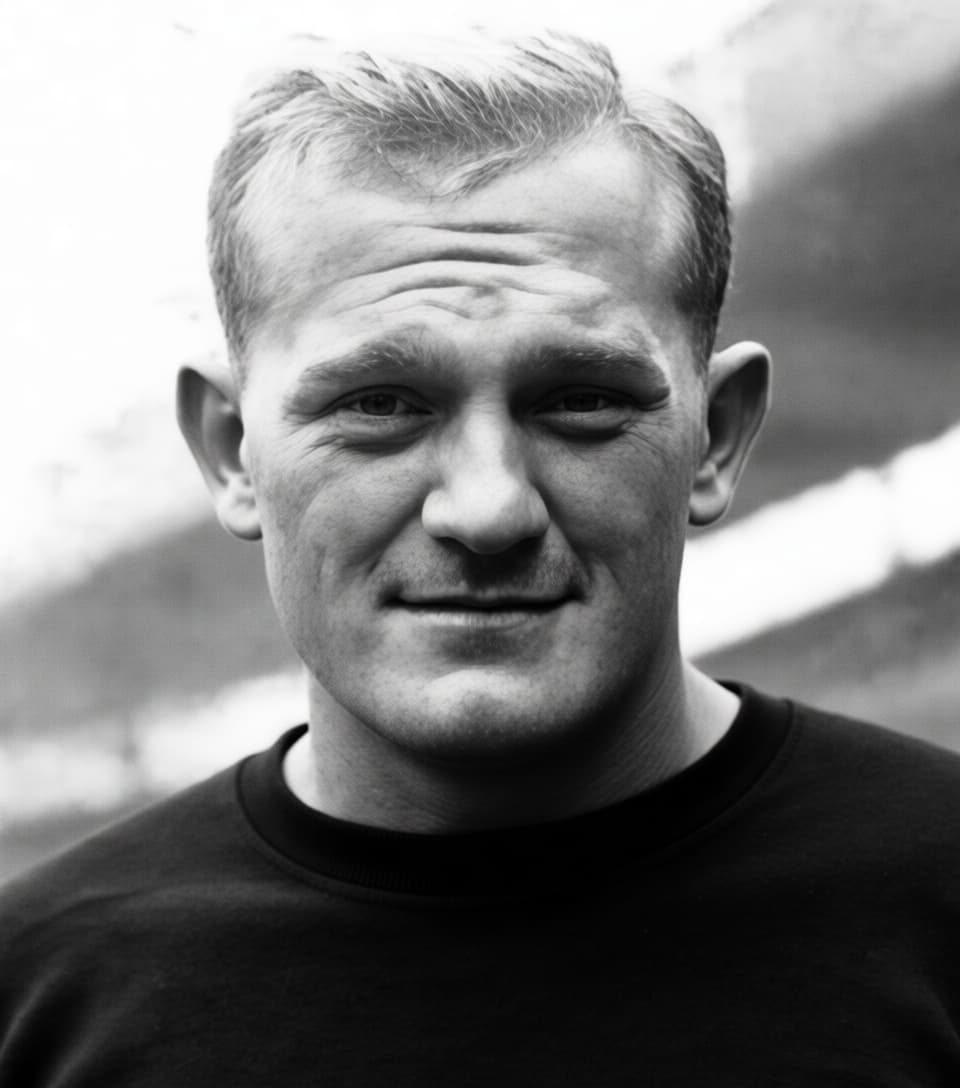
Cal Hubbard portrait.
Photo credit: User-provided image via User-provided image
Robert Calvin Hubbard weighed 250 pounds, ran the hundred-yard dash in 11 seconds, and won four NFL championships as a tackle for the New York Giants and Green Bay Packers before he walked away from football and became one of the finest umpires the American League ever employed. He worked 2,470 regular season games, four World Series, and three All-Star Games across 16 seasons, then spent 17 more as the league's supervisor of umpires. His eyesight tested at 20/10 at a Boston optical laboratory, sharper than Ted Williams at the same facility. He is the only person inducted into both the Pro Football Hall of Fame and the National Baseball Hall of Fame.
Keytesville
Hubbard was born on October 31, 1900, in Keytesville, Missouri, a farming town of about a thousand people in the north-central part of the state. His parents were Robert Porter Hubbard and Sarah "Sallie" Ford Hubbard, and he was one of six children, though two brothers died in infancy and his brother John died at 16. His brother Thomas, who lived until 1954, remained close throughout his life. Hubbard grew to 200 pounds by 14 and began umpiring sandlot games at 18, where his size and command of the rules earned him the nickname "The Enforcer."
Hubbard attended Keytesville High School, spent a year at Chillicothe Business College, and then followed his football hero, coach Bo McMillin, to Centenary College in Shreveport, Louisiana, in 1922. He played tackle, ran track, wrestled, boxed, and made the baseball team only because the school was too small to cut anyone. McMillin barred him from team scrimmages "for fear of injuring his teammates." Hubbard's explanation was simpler. "I liked to hit people," he said.
Hubbard transferred to Geneva College in Beaver Falls, Pennsylvania, in 1925, sat out the football season under eligibility rules, and worked in a local steel mill. He joined the track team and set the school discus record at 142 feet 8 inches. When he returned to the field in 1926, Geneva upset Harvard in one of the most stunning results of the college football season, and Hubbard played the dominant role. His roommate Paul "Pip" Booth said he "moved like a cat and always smashed into the ball carrier with his face or chest. Once I saw him smash down the whole side of a defensive line by himself." A college professor offered the other side of the man. "Big Cal was as kind and generous a man off the field as he was an untamed savage on it." Hubbard earned his bachelor's degree in 1927 after three colleges and seven years. "Not exactly what you would call a professional student," he said.
Four Championships
Hubbard aspired to attend West Point, but the academy rejected him after a physical exam revealed flat feet. Instead he signed with the New York Giants in 1927 at $150 a game and teamed with tackle Steve Owen on one of the most dominant defensive lines in the early NFL. The 1927 Giants shut out their opponents 10 times in 13 games, allowed only 20 points the entire season, and won the championship.
Hubbard hated every minute of living in New York. After a road game in Green Bay following the 1928 season, he told coach Curly Lambeau he would retire from football before playing another year in a big city, and the Giants traded him. Green Bay won three consecutive championships from 1929 through 1931, and Hubbard added three more first-team All-Pro selections in 1931, 1932, and 1933 to the one he earned with the Giants in 1927. Quarterbacks learned to fear a man they couldn't locate before the snap. He lined up at tackle on some plays and roamed behind the line on others, freelancing in a way that anticipated the linebacker position by decades. Harry Newman, who played quarterback against him for years, said, "Green Bay had the most brutal lineman in the game. He played with the intensity that Dick Butkus did. We used to say of Cal that even if he missed you, he hurt you."
Hubbard left to coach the Texas A&M line in 1934, returned to Green Bay in 1935, and played one more season split between the Pittsburgh Pirates and the Giants in 1936. He retired for good in December after watching teammate Les Corzine break his leg in three places during his final game. Hubbard announced to the opposing team, "If any of you guys has a grudge against me, get it out of your system in the next minute and five seconds. This is your last shot at me." He walked off the field at 36 with four championships, four first-team All-Pro selections, and a reputation as the most punishing tackle of his generation.
Between Seasons
Hubbard started umpiring professionally in 1928, when a friend suggested he write to Judge William G. Bramham, head of the minor leagues, about working between football seasons. Bramham was "so impressed with Cal's quiet confidence, style, and knowledge of the rules that he hired him immediately." McMillin, who coached him in college, thought it made perfect sense. "He was born to be an official," McMillin said. "As a player, he knew more about the rules than the officials. He spent more time studying them. He was a fanatic on rules."
Hubbard worked his way up through the minors over eight springs and summers while playing professional football in the fall, umpiring in the Piedmont League, the South Atlantic League, the Western League, and the International League and traveling through 17 states and two Canadian provinces. He developed a fondness for opera along the way. In Macon, Georgia, in 1929, Hubbard agreed to box a local fighter named Spike Webb on Labor Day to win over a hostile crowd. The strategy was to swing his massive fists at a furious pace and overwhelm Webb early. It worked for three rounds, but Hubbard was so exhausted by the fourth that he threw in the towel. The Macon fans never heckled him again.
The American League
Hubbard reached the major leagues on April 14, 1936, and for the remainder of that year he spent summers calling balls and strikes and autumns hitting people for money. When he retired from football that December, he became a permanent umpire, and veteran colleagues praised him as the best newcomer they ever saw.
His physical presence preceded any call he made. At six-three and 250 pounds, he was by far the largest umpire in the league, and his reputation as a professional football player discouraged most arguments before they started. In 2,470 regular season games he ejected only 64 players, a rate near the bottom among his contemporaries. "I always hated to throw a guy out of a game," he said, "but sometimes it was necessary to keep order." Hubbard brought a scholar's command of the rulebook and a confidence behind the plate that contrasted with the bravado of his predecessors. Bill Klem, the great National League umpire, proclaimed, "I never called one wrong." Hubbard told players the opposite. "Boys, I'm one of those umpires that can make a mistake on the close ones. So, if it's close, you'd better hit it."
His eyesight, tested at Boston's American Optical Laboratory, measured 20/10, the strongest the lab ever recorded. He was modest about it. "But I didn't have to call many strikes on Williams," he said. "If it was a strike, he hit it."
Commissioner Kenesaw Mountain Landis selected Hubbard for the 1937 World Series but revoked the assignment after learning he visited a racetrack. Hubbard protested that he didn't even remember whether the horse won and only bet five bucks. Hubbard received his first Series assignment the following year, in 1938, and worked three more in 1942, 1946, and 1949. He also umpired three All-Star Games in 1939, 1944, and 1949.
On July 20, 1944, he became the first umpire to enforce the spitball rule on the books since 1920. Nelson Potter of the St. Louis Browns kept licking his fingers on the mound despite repeated warnings, and Hubbard ejected him. Potter received a 10-day suspension. The pitcher maintained he never threw a spitter, just had a habit of going to his mouth and then the rosin bag. Hubbard agreed with the distinction. "I never said he was throwing spitters," he said. "I just said he was violating pitching rules."
His rapport with Yogi Berra produced the most entertaining umpire-player relationship of the era. On June 11, 1948, Hubbard ejected the young catcher for the first time in his career, and the Yankee Stadium crowd responded by showering the field with newspapers, cans, and bottles. A fan hurled a beer can that barely missed Hubbard's head. Berra apologized afterward, and the two developed an ongoing routine. Berra liked to reference Hubbard's football days. "I think you got hit in the head once too much," he would tell him. During a sweltering game in Boston, Berra deliberately cursed at Hubbard hoping to get tossed and escape the heat. Hubbard saw through it. "Yogi, you could call me anything you want," he said. "If I'm going to suffer, you're going to suffer with me."
In 1945, Philadelphia Athletics catcher Charlie George punched Hubbard's partner Joe Rue during an argument at the plate. Hubbard wrapped his arms around Rue before he could retaliate. "It was a good thing he did," Rue said later, "because I might have killed him." Hubbard pointed at George and told him he would never play another game in the big leagues. George never did.
Hubbard worked the last regular season game of 1949 between the Red Sox and Yankees, with the pennant riding on every pitch. The league assigned six umpires and put Hubbard behind the plate. After the game, Boston catcher Birdie Tebbetts told him he had worked a perfect game. "It is always easy for a catcher to tell you how well you've done," Hubbard replied, "if his team had won." In 1951 Hubbard worked behind the plate when Allie Reynolds pitched a game without a hit at Yankee Stadium.
Milan
On December 10, 1951, Hubbard went quail hunting in the prairies near his home in Milan, Missouri, with a group that included fellow umpire Al Barlick. A neighbor boy took a shot at a passing rabbit, and the bullet ricocheted. A pellet the size of a pinhead entered Hubbard's left eye just above the pupil. A local doctor treated the wound, and Hubbard traveled to St. Louis, where specialists decided the risk of surgery was too great. Hubbard visited eye surgeons in Pittsburgh who specialized in removing metal from steelworkers' eyes, but none would attempt the operation.
Hubbard could still see out of the eye, but his depth perception was gone. He asked his sons to play pitcher and catcher while he stood behind the plate at home, and his heart sank when he realized he could no longer track the ball. Doctors said the vision might recover with rest. It did not.
The depression that followed was unlike anything his family knew. Friends tried to lift his spirits with visits and football talk, but Hubbard spent his days staring into space. He lost interest in bridge, in conversation, in everything that once gave him pleasure. His wife Ruth felt helpless watching the change from his usual nature. When he learned that Bo McMillin, his old college coach and the man who started him in football, died, the spiral deepened. On Opening Day 1952, Hubbard wept.
Then American League president Will Harridge called. Tom Connolly, the league's supervisor of umpires, needed an assistant, and Harridge wanted Hubbard for the job. Hubbard accepted immediately. "It would have broken my heart to be forced out of baseball," he said. "This is wonderful and thank you a million."
The Supervisor
Hubbard served as Connolly's assistant from 1952 through 1954, a period that coincided with the introduction of four-man umpire crews for regular season games. He devised the new mechanics, created charts outlining rotations and positioning, and defined each umpire's duties for every possible play. The system he designed remains the foundation for how crews operate today.
When Connolly retired in 1954, Hubbard took over as the American League's supervisor of umpires and held the position for 15 years. He traveled constantly, visiting AL ballparks to observe his umpires and scouting the minors for talent. He opened every banquet speech the same way. "I can speak on only three subjects," he would say, "football, baseball, and bird dogs."
Hubbard preferred big men with quiet dispositions who called plays with understated gestures. Joe Paparella, who learned the trade under him, said Hubbard "hated what he called showboating. When Cal took over as supervisor, he toned us down quite a bit. 'I don't want your sacrificing judgment for color,' those were his famous words." Paparella also said Hubbard taught him more about umpiring in one year than he had ever dreamed there was to learn. "If I wasn't in the right position, he'd move me over, and if I was calling pitches too quick, he'd flash me a sign." Hubbard's philosophy was spare. "If you can't control yourself," he told his umpires, "you can't control a ball game."
When it came time to hire the first black umpire in major league history, Hubbard and American League president Joe Cronin chose Emmett Ashford in 1966, one of the most flamboyant arbiters the game produced. After Ashford's historic first game, Hubbard gave him a hug. "Cal and I became good friends," Ashford said. "When some of the umpires were getting set to organize against me, he quelled the uprising."
Cronin also appointed Hubbard to the major league Rules Committee in 1959, where he pushed for faster play and lobbied unsuccessfully to legalize the spitball. He called the existing ban "unenforceable" and joked about banning the knuckleball instead. "They outlawed the spitter, Christ, they ought to outlaw that knuckle ball," he said. "You don't know where the hell it's going. To umpire knuckle ball pitchers, you've got to wait because if you call it too quick, hell, you're liable to miss it a mile."
Hubbard retired from baseball in 1969 amid a dispute over umpire unionization. Cronin fired Al Salerno and Bill Valentine, officially for incompetence but widely believed to be retaliation for their efforts to organize a union. Hubbard was caught between his loyalty to his umpires and his boss, and he chose to step away rather than navigate the mess any further.
Cooperstown
The College Football Hall of Fame inducted Hubbard in 1962, and the Pro Football Hall of Fame enshrined him the following year as a charter member. George Halas, who coached against him for years with the Chicago Bears, offered the tribute that followed Hubbard for the rest of his life. "There never was a better lineman," Halas said, "than that big umpire."
His wife Ruth died in 1964. Robert Freeman, one of Hubbard's closest friends in Milan, died not long after, and Hubbard consoled Freeman's widow Mildred. Their friendship became a romance, and they married in 1966.
The Veterans Committee elected Hubbard to the Baseball Hall of Fame in 1976, making him the only person enshrined in both the baseball and football halls. The ceremony that August was the first ever held indoors because of rain. Hubbard walked onto the stage using a cane and breathing heavily from the emphysema that would kill him, but he still projected a formidable figure, beaming as he acknowledged his family and the crowd.
Hubbard spent his final years between Milan and St. Petersburg, Florida, where doctors recommended the warmer climate for his lungs. He was proud of both careers but modest about them, and late in life he said that sports heroes were "glamorized because they are constantly in the limelight, but as I look back over the years that have brought honor to me, I realize that I fall short of the dimensions of many of the nation's unsung heroes." Hubbard died of cancer on October 17, 1977, in St. Petersburg, two weeks before his 77th birthday. His body was brought home to Milan for burial at Oakwood Cemetery. The high school football field in Milan and the high school baseball field in Keytesville both bear his name.