Profile
Will Harridge
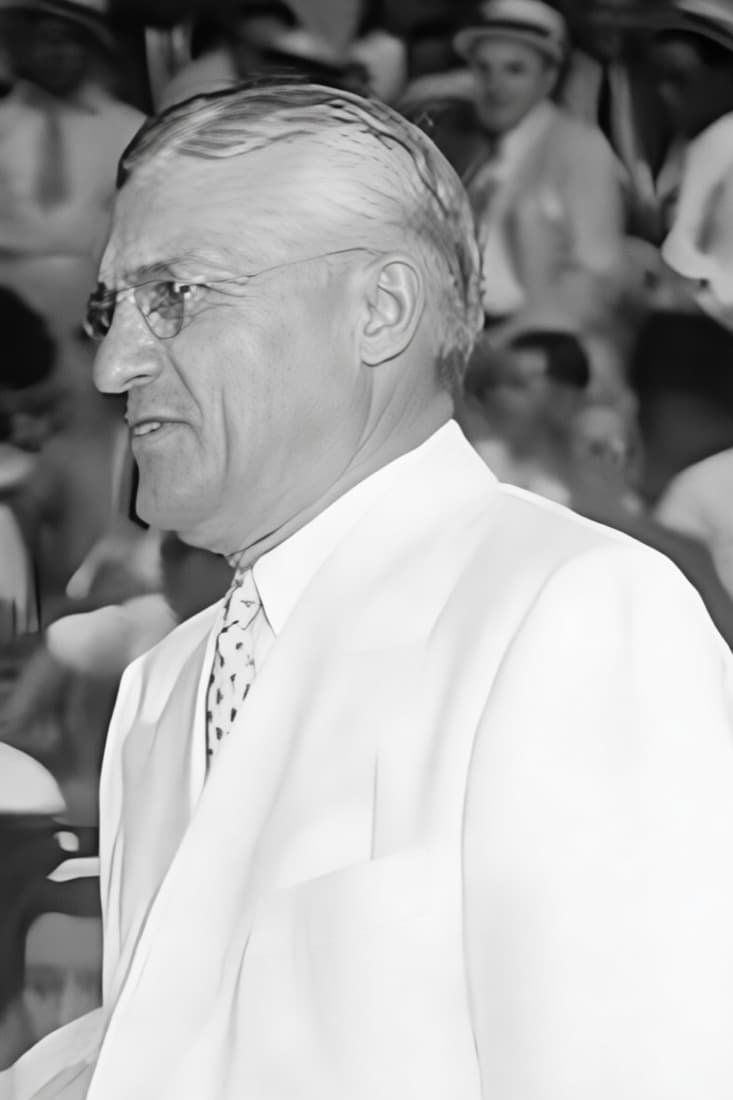
Will Harridge portrait.
Photo credit: User-provided image via User-provided image
William Harridge claimed he had never watched a baseball game before the age of 30, never played one at any level, and stumbled into the sport because he was good at booking train tickets. He served the American League for 47 years, 27 of them as president, and ran the office so quietly that Phil Ball of the St. Louis Browns, upon nominating him for the job in 1931, said, "I nominate Will Harridge for president and treasurer. I hope he is not elected, for, if he is, we are going to lose a darn good secretary."
Chicago
Harridge was born on October 16, 1881, in the Hyde Park neighborhood of Chicago. His parents, David and Barbara, were English emigrants who had arrived on the South Side in 1875 and raised four children. He attended Hyde Park High School and took night business classes while working as an office boy at the Wabash Railroad. He rose quickly and was eventually put in charge of arranging travel for sports groups and theatrical companies. The American League, headquartered in Chicago, used the Wabash for umpire transportation, and Harridge's efficiency in managing those bookings caught the attention of AL president Ban Johnson.
In December 1911, Johnson hired Harridge as his personal secretary at $50 per week, up from $90 per month at the railroad. His boss at the Wabash told him he was "through," and Harridge stood stunned until he learned Johnson had arranged his departure. He married Maude Hunter of Decatur, Illinois, roughly six months before he started the job. They had one son, William Jr., who became a surgeon in Chicago.
Secretary
Harridge served Johnson for 16 years through the Federal League war, the First World War, the Black Sox gambling scandal, and Johnson's escalating conflicts with Commissioner Kenesaw Mountain Landis. Johnson was demanding and volatile, and by the late 1920s his grip on the league was slipping. When the owners forced Johnson toward retirement in 1927, Johnson accused Harridge of misplacing petty cash and fired him. The owners overruled the dismissal, assigned Harridge a separate office, and named him league secretary.
Ernest Barnard succeeded Johnson as president and served until his death on March 27, 1931. The owners elected Harridge to replace him on May 27, 1931, with a three-year contract. "Each did wonders for the organization and for baseball in general," Harridge said of Johnson and Barnard. "I hope I will be able to carry on their ideals."
President
He ran the American League from 1931 through 1958, exceeding Johnson's 26-year tenure by one year but governing by temperament rather than decree. Where Johnson had ruled as an autocrat, Harridge operated at the behest of the owners. His hobbies were work and bridge. He drove a car for commuting and weekend outings and took his first summer vacation in 1930, after 19 years on the job, only because Barnard insisted he take up golf.
His toughest early decision came in 1932. Yankees catcher Bill Dickey punched Washington outfielder Carl Reynolds at home plate and broke his jaw. Harridge fined Dickey $1,000 and suspended him for 30 games. Yankees owner Jacob Ruppert refused to speak to Harridge for almost a year but eventually became, as Harridge put it, "one of my best friends."
In the winter of 1933, Chicago Tribune sports editor Arch Ward proposed a one-time interleague exhibition game over dinner with Harridge. Harridge lobbied AL owners for approval, and the inaugural All-Star Game took place at Comiskey Park on July 6, 1933, before 47,595 fans. Lefty Gomez started for the American League, Babe Ruth hit a two-run home run, and the AL won 4-2. The game succeeded so thoroughly it became an annual tradition, and Harridge was a fierce partisan. When Ted Williams hit a ninth-inning home run to win the 1941 All-Star Game in Detroit, Harridge said, "I'd have kissed him, if there had not been so many people around."
On August 19, 1951, Browns owner Bill Veeck sent Eddie Gaedel to the plate. Gaedel was three feet seven inches tall and walked on four pitches. Harridge voided the contract the next day, declaring that Veeck was "making a mockery of the game by employing an obviously unqualified player."
He approved the Browns' move to Baltimore in 1954 and the Athletics' relocation from Philadelphia to Kansas City in 1955. The Kansas City deal drew criticism because Arnold Johnson, the new owner, had existing financial ties to the Yankees, and some observers believed Harridge had not explored alternative local ownership thoroughly enough.
The American League was slower than the National to integrate after Jackie Robinson broke the color line in 1947, and the competitive consequences of that delay grew more visible each year as NL rosters filled with players like Willie Mays and Hank Aaron. The lag happened on Harridge's watch, though no specific action for or against integration is documented in the record.
Resignation
Harridge resigned as president in December 1958. "With the many problems facing baseball, I feel they are entitled to a younger man," he said. Joe Cronin, general manager of the Red Sox, replaced him. Harridge was named chairman of the board and retained his office, his secretary, and his role at all league meetings. The American League Championship Series trophy was later named the William Harridge Trophy in his honor.
His wife Maude died after a long illness in late 1956. His son William Jr. died of cancer in January 1971, and Harridge declined quickly after that. He died on April 9, 1971, in Evanston, Illinois, at 89, and was buried at Memorial Park Cemetery in Skokie.
The Veterans Committee elected him to the Hall of Fame in 1972, one year after his death, recognizing 59 years of service to the American League. He had started as a railroad clerk booking train tickets for umpires. By 1956, despite his claim of never watching a game before 30, he was attending 75 games a year.