Profile
Chuck Klein
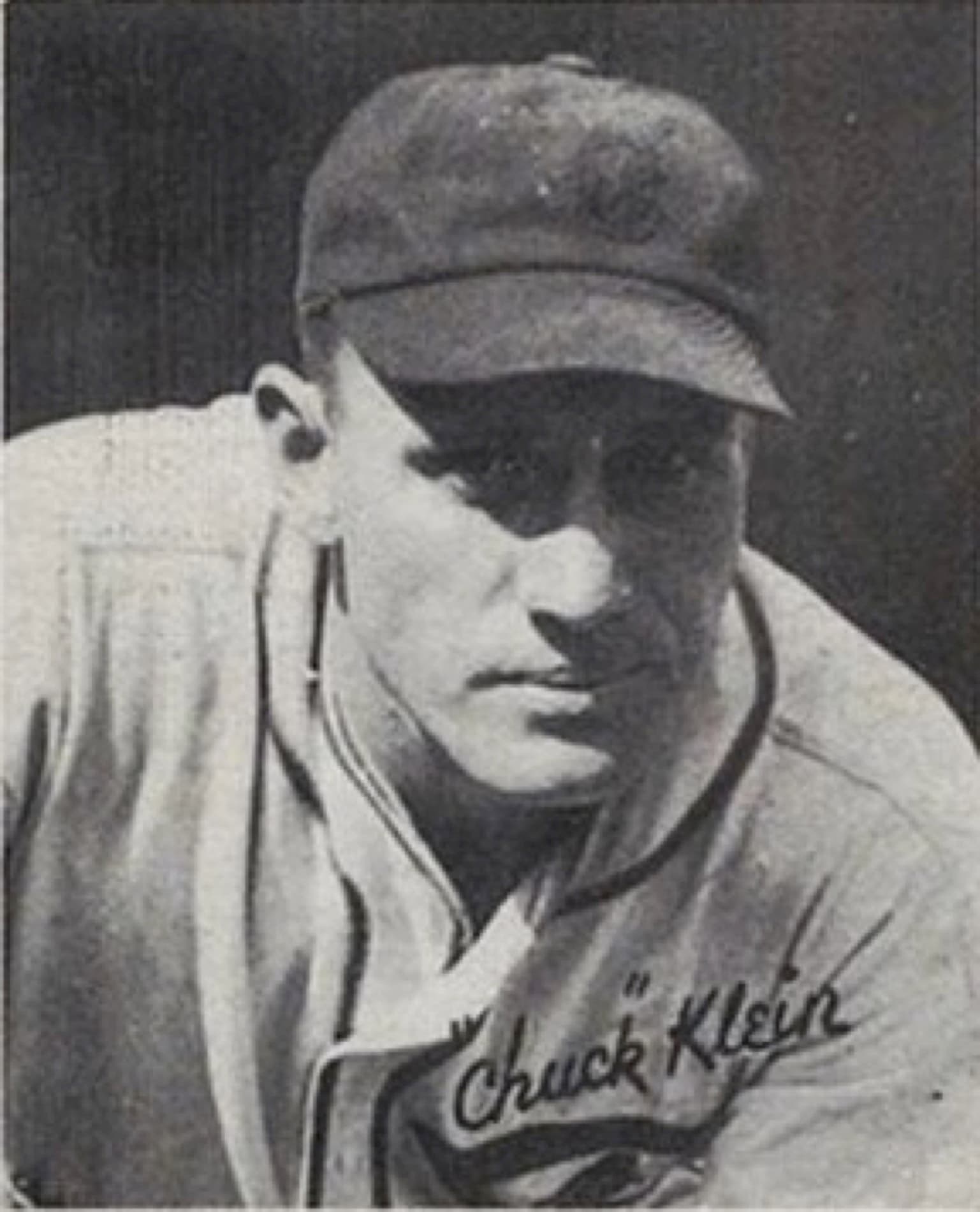
Chuck Klein portrait from 1936 Goudey.
Photo credit: Goudey via Wikimedia Commons (Public domain)
Charles Herbert Klein won the Triple Crown, led the National League in home runs four times, and from 1929 through 1933 hit with a sustained ferocity that placed him alongside Babe Ruth and Lou Gehrig as the most productive sluggers in baseball. Baker Bowl, where the Phillies played their home games with a right field fence 280 feet from home plate and a 60-foot tin wall above it, inflated his numbers without question. Klein knew it. Opponents knew it. "I find it very difficult to realize that I, Chuck Klein, the chap who was working in a steel mill three years ago, am the same fellow who led the National League in home runs this season," Klein said after 1929. "Isn't that a laugh?" The Veterans Committee elected him to the Hall of Fame in 1980.
Indianapolis
Klein was born on October 7, 1904, in Indianapolis, Indiana. His father Frank was a deputy sheriff and farmer, and his mother Margaret was a German immigrant. Klein attended Southport High School with poor grades, graduated in 1923, and went to work on road crews and in steel mills. He spent three years heaving 200-pound hot ingots into a blast furnace at Chapman-Prico Steel Mill six days a week while playing semipro baseball for the Keystone Athletic Club on evenings and weekends.
A Prohibition agent named Adolph Stahlman spotted Klein playing for the Keystones in August 1927 and recommended him to the Evansville Hubs of the Three-I League. Klein broke his ankle sliding into third base in his 15th professional game. The following year he hit .331 with 26 home runs for Fort Wayne in the Central League, and the Phillies purchased his contract for $7,500 after Commissioner Kenesaw Mountain Landis forced the Cardinals to divest a competing team in the same league. Manager Burt Shotton greeted Klein at the Phillies' clubhouse with the only welcome that franchise could offer. "They tell me you can hit," Shotton said. "God knows we need hitters."
Baker Bowl
Klein debuted on July 30, 1928, and hit .360 in 64 games. From there Klein became nearly unstoppable. In 1929 he hit 43 home runs, a new National League record at the time. In 1930 he batted .386 with 40 home runs, 170 RBI, 158 runs scored (a modern NL record that still stands), 59 doubles, and 44 outfield assists (also still a record). The Phillies finished 52-102 with a team ERA of 6.71, and Klein finished in the middle of a batting race behind Bill Terry at .401, Babe Herman at .393, and Lefty O'Doul at .383.
Klein won the NL MVP in 1932, hitting .348 with 38 home runs, 137 RBI, and 20 stolen bases, becoming the only player since 1920 to lead the league in both home runs and steals in the same season. In 1933 he won the Triple Crown with a .368 average, 28 home runs, and 120 RBI, and hit for the cycle on May 26 against Dizzy Dean and the Cardinals. Klein finished second in MVP voting behind Carl Hubbell.
Over five seasons from 1929 through 1933, Klein averaged .359 with 36 home runs, 139 RBI, and 224 hits per year. The Phillies traded him to the Cubs in November 1933 for three players and $65,000, the most cash involved in a transaction to that point.
The Decline
A torn leg muscle in May 1934 hampered Klein for the rest of his time in Chicago. Billy Herman, a Cubs teammate, said, "No player would have played with the injured leg that Chuck had with the Cubs." Klein contributed to the Cubs' 1935 pennant and hit a home run off Schoolboy Rowe that scored two in Game 5 of the World Series against Detroit.
The Cubs sent Klein back to Philadelphia in May 1936, and on July 10 he hit four home runs in a 10-inning game at Forbes Field against the Pirates, the fourth player in major league history and the first National Leaguer in the twentieth century to accomplish the feat. When the Phillies moved from Baker Bowl to Shibe Park in July 1938, where right field was 51 feet deeper, Klein hit only two more home runs the rest of that season.
Klein hit his 300th career home run as a pinch hitter on August 18, 1941, and spent his final seasons pinching hitting before retiring in 1944. He coached for the Phillies through 1945, then opened a neighborhood tavern in the Kensington section of Philadelphia. Klein suffered a stroke in 1947 that paralyzed one leg, and he returned to Indianapolis, where his brother provided nursing care for the remainder of his life. Klein gave up drinking entirely after the stroke and abstained for 11 years. He died of a cerebral hemorrhage on March 28, 1958, in Indianapolis, at 53.
Edward "Dutch" Doyle, a Philadelphia schoolteacher, spent more than a decade writing letters to the Hall of Fame and sportswriters alongside Klein's sister-in-law Virginia Torpey, campaigning for his election. The Veterans Committee elected Klein in 1980, 22 years after his death. His nephew Bob Klein accepted the honor at Cooperstown.