Profile
Ray Brown
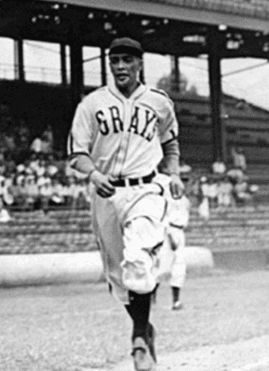
Ray Brown portrait with the Homestead Grays.
Raymond Brown graduated from Alger High School in a class of 19 students, left a foundry job in Dayton to pitch for the Homestead Grays, and spent 14 seasons proving he could throw a curveball on a 3-0 count and make hitters miss. He won 119 games and lost 46 for a .721 winning percentage, posted a 3.12 ERA, threw 140 complete games, and led the Grays to eight pennants in nine years from 1937 through 1945. Josh Gibson told reporters that Brown's composure and smooth delivery would help him defeat Satchel Paige in any matchup. Hilton Smith ranked him alongside Paige and Bob Feller. The Special Committee on Negro Leagues elected him to the Hall of Fame in 2006, 41 years after his death.
Alger
Brown was born on February 23, 1908, in Alger, Ohio, a village in Hardin County with fewer than 1,000 residents. His father Edgar worked as a farm laborer. His mother Martha, born in North Carolina, raised a blended family with children from a previous marriage. Brown played baseball and basketball at Alger High School, catching in a 15-5 loss to Mt. Victory during the 1926 season, and graduated in a class of 19.
Brown left Alger for Dayton, where he worked as a foundry laborer and pitched for the Dayton Marcos, a barnstorming team. In 1931, at 23, he joined the Indianapolis ABCs. In 1932 he played outfield and pitched for the Detroit Wolves, batting third or cleanup, before Cum Posey acquired him for the Homestead Grays in late July. Brown never left.
The Grays
Brown anchored the Homestead Grays pitching staff for 14 seasons. In 1935 he went 12-3 and started the East-West All-Star Game. In 1938 he won the Negro National League pitching Triple Crown with 14 wins, 70 strikeouts, and a 1.88 ERA, going 14-0 in league play and setting the record for most wins in a season without a loss. In 1940 he posted an 18-3 record with a 2.53 ERA. Across the 1936-37 seasons he ran off a winning streak of 28 games, and in 1941 he put together 27 consecutive wins against all levels of competition.
Brown married Ethel Posey, daughter of Grays owner Cumberland Posey, in June 1937. A persistent legend placed the wedding at home plate on July 4, 1935, but the Pittsburgh Courier announced the marriage in June 1937, and the SABR BioProject found no evidence for the earlier date. The couple had a son, Truman Posey Brown, born in 1942. They later divorced.
Brown's curveball was his signature pitch. He threw it on any count with supreme confidence, mixing it with a fastball, sinker, slider, and later a knuckleball. James Riley noted that Brown "would throw a curve with a 3-0 count on the batter." Josh Gibson said that Brown's calmness and smooth delivery would ultimately help him defeat Satchel Paige.
October
The Grays won the Negro World Series in 1943 and 1944. Brown went 3-2 across seven World Series games from 1942 through 1945. On September 21, 1944, he threw a shutout that allowed one hit against the Birmingham Black Barons, winning 9-0 to clinch the championship for the Grays. In 1945, he threw a perfect game across seven innings against the Chicago American Giants.
In 1938, the Pittsburgh Courier sent a wire to the Pittsburgh Pirates naming five Negro Leaguers who "would be certain major leaguers if allowed to play." The five were Ray Brown, Josh Gibson, Buck Leonard, Cool Papa Bell, and Satchel Paige. All five reached the Hall of Fame.
Cuba, Mexico, Canada
Brown spent five winters pitching for Santa Clara in the Cuban Winter League, compiling a 46-20 record with 57 complete games. In 1936-37 he went 21-3, pitching 23 of 26 starts to completion, and won the championship the following winter with a league-leading 12 wins. He threw a no-hitter for Santa Clara against Havana on November 17, 1936. In one winter in Puerto Rico he went undefeated. In another he posted a 12-4 record with a 1.80 ERA.
In 1946, Brown jumped to the Mexican League before Jackie Robinson broke the color line. Commissioner Happy Chandler banned all players who left for Mexico from organized baseball. By the time the ban ended in June 1949, Brown was 41. He pitched four summers in Mexico, going 51-36 with a 3.31 ERA, then moved to Canada, where he won a league championship with Thetford Mines in 1952, going 16-5 as the club MVP, and managed the Lachine Indians to a pennant in 1953.
Dayton
Brown returned to Dayton after his second divorce in 1958. He worked at the Sunshine Biscuit Company and later the Standard Biscuit Company, described by those who knew him as "a pleasant, quiet man" who never discussed his baseball career. He died on February 8, 1965, fifteen days before his 57th birthday.
His grave at Greencastle Cemetery in Dayton went unmarked for 43 years. In July 2008, private citizens placed a tombstone. The Washington Nationals inducted him into their Ring of Honor on August 10, 2010. The Homestead Grays Bridge in Pittsburgh carries signs honoring Brown alongside Josh Gibson and Buck Leonard.
Brown finished with 119 wins, 46 losses, a .721 winning percentage, a 3.12 ERA, 719 strikeouts, 140 complete games, and 18 shutouts across 216 documented games. He made two East-West All-Star teams, won two Negro World Series, pitched across five winters in Cuba and four summers in Mexico, and threw a perfect game. Cuba inducted him into its Baseball Hall of Fame in 1998.