Profile
Sol White
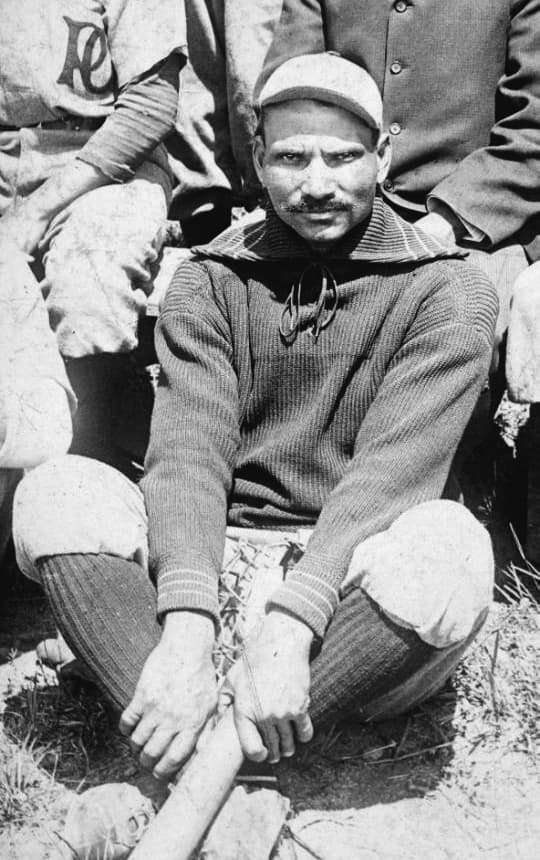
Sol White portrait with the Philadelphia Giants, 1902.
Photo credit: Unknown photographer via Wikimedia Commons (Public domain)
King Solomon White played second base on integrated minor league teams in the 1880s and 1890s, never batted below .324 across five seasons of organized white baseball, co-founded the Philadelphia Giants and managed them to four consecutive black baseball championships, and then wrote a 128-page book about it all because nobody else was going to. Sol White's Official Base Ball Guide, published in 1907, was the first book devoted to black professional baseball and remained the only work on the subject for more than 60 years, until Robert W. Peterson published Only the Ball Was White in 1970. Jerry Malloy called it "the Dead Sea Scrolls of black professional baseball's pioneering community." Only five copies are known to exist. White died penniless in 1955 at 87 and was buried in an unmarked communal grave on Staten Island. The Special Committee on Negro Leagues elected him to the Hall of Fame in 2006, and Commissioner Bud Selig accepted the plaque because no family member was present.
Bellaire
White was born on June 12, 1868, in Bellaire, Ohio, across the Ohio River from Wheeling, West Virginia. His father Saul died when Sol was young, and his mother Judith worked as a washerwoman to support five children. White started playing baseball as a teenager for the Bellaire Globes, and when a teammate smashed his finger, the Globes' captain pushed White into the game as a replacement. The opposing team captain that day was Ban Johnson, future American League president, leading "a hick town club" from Marietta.
In 1887, White joined the Wheeling Green Stockings of the Ohio State League, a predominantly white team, and batted .370 in 52 games with a .502 slugging percentage. That same summer, the League of Colored Baseball Clubs formed and collapsed within weeks, and Cap Anson's campaign against black players gained force across organized baseball. The Ohio State League renamed itself the Tri-State League after the season and banned black players. When White was reassigned to Wheeling, manager Al Buckenberger refused to accept him. White later wrote that Cap Anson possessed "all the venom of a hate which would be worthy of a Tillman or a Vardaman of the present day," referencing notorious segregationist politicians.
White played for the York Colored Monarchs of the Eastern Interstate League in 1890, batting .350 with 21 stolen bases in 54 games. In 1895, he replaced Bud Fowler at second base on the Page Fence Giants, a team funded by the Page Woven Wire Fence Company that traveled by private rail coach and had no home field. White batted .404 and the team went 118-36-2. Across his five seasons in integrated minor league baseball, he batted .356 in 159 games with 174 runs scored and 54 stolen bases.
Philadelphia
White enrolled at Wilberforce University in 1896 as a theology major, attending during off-seasons while playing summers for the Cuban X-Giants. Malloy noted that Wilberforce "developed the innate interest in history that ultimately made him the Livy of African American baseball."
In 1902, White co-founded the Philadelphia Giants with H. Walter Schlichter, sports editor of the Philadelphia Item, and Harry Smith, sports editor of the Philadelphia Tribune. White served as captain and field manager. He recruited Frank Grant, and in 1904 he brought in Rube Foster as a pitcher and Pete Hill as an outfielder. In 1907, he added John Henry Lloyd at shortstop and Bruce Petway behind the plate.
The Philadelphia Giants won four consecutive black baseball championships from 1904 through 1907. In 1905, the team went 134-21-3, and promoter Nat Strong called them "the best team in the history of the game." In 1906, after a 108-31-6 season, White issued a public challenge to play either the NL-pennant-winning Chicago Cubs or the World Series-winning Chicago White Sox. Neither team responded.
White described the economics bluntly in his book, writing, "The average major leaguer made $2,000.00 in 1906, while the average black netted only $466.00." He left the Philadelphia Giants in 1909 following a disagreement with Schlichter, and the team declined rapidly without him.
The Book
Sol White's Official Base Ball Guide was published in 1907 as a 128-page softcover pamphlet sold at Philadelphia Giants games. White and Schlichter shared the copyright. The guide traced the history of black professional baseball from the first organized team in 1885, documented salary disparities and travel hardships, included essays by Rube Foster on pitching and Grant "Home Run" Johnson on hitting, reproduced an appeal against the color line by Welday Walker, and preserved the names and records of dozens of players and teams that would otherwise have vanished entirely.
Larry Lester said, "Sol White's History of Colored Base Ball is the only legitimate document out there that recognizes the early days of the Black game" and called it "required reading for any serious scholar." Leslie Heaphy of Kent State said, "Still to this day, his book is one of the best resources we have to understanding the early participation of African Americans in baseball." Red Barber called it "an entertaining, as well as an historical, account of the Negro players who wanted to play baseball badly enough to struggle against discrimination."
White attempted to publish a second edition updating the history through the Negro Leagues era. The Pittsburgh Courier reported in 1927 that White sought publishers for the project. The second book never found one.
Harlem
After his playing career ended around 1911, White managed and coached teams intermittently through 1926, including the New York Lincoln Giants, the Cleveland Browns, and the Newark Stars of the Eastern Colored League, and served as secretary of the Columbus Buckeyes in the Negro National League. William "Big C" Johnson, who played for White in Cleveland, called him "the best educated man I ever played with. Sol wanted what they never were able to get, a reporter to keep records."
White wrote sports columns for the Cleveland Advocate, the New York Age, and the New York Amsterdam News through the 1920s, continuing the historical work his book began. He predicted integration decades before it came, writing, "Some day the bar will drop and some good man will be chosen from out of the colored profession that will be a credit to all, and pave the way for others to follow." Frank Ceresi and Carol McMains wrote, "What quiet pride Sol must have felt when, as an old man living alone in Harlem, he saw Jackie Robinson break down the blight on the game." White was 78 when Robinson debuted on April 15, 1947.
White spent his final years alone in Harlem. He died on August 26, 1955, at 87, likely at the Central Islip State Hospital on Long Island. He was buried in Frederick Douglass Memorial Park on Staten Island in an unmarked communal grave. The grave remained unmarked for more than 50 years until the Negro Leagues Baseball Grave Marker Project installed a headstone. An Ohio Historical Marker was placed in Union Square in Bellaire in September 2024, commemorating White as a native son.
White played second base, third base, shortstop, and outfield across a professional career spanning 1887 through at least 1909, batted .356 in organized white baseball, managed the most successful black baseball team of the early twentieth century, and wrote the book that preserved its history. John Holway called him "an infielder who would go on to become the most influential figure in the first decades of Negro baseball." White himself wrote in 1907, "Baseball is a legitimate profession. It should be taken seriously by the colored player. An honest effort of his great ability will open the avenue in the near future wherein he may walk hand in hand with the opposite race in the greatest of all American games."