Profile
Pete Hill
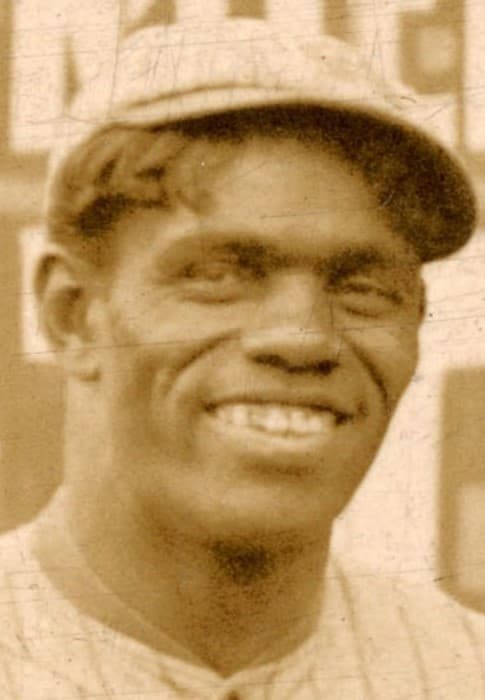
Pete Hill portrait in Chicago American Giants uniform.
Photo credit: Unknown photographer via Wikipedia
John Preston Hill left Virginia at seven, grew up in Pittsburgh, and spent 27 years playing center field for every team Rube Foster assembled. He batted .303 across documented games (and higher by other measures in a sport where the box scores survived only in fragments), led the Cuban Winter League in hitting, captained the Chicago American Giants for nearly a decade, managed the Detroit Stars in the first season of the Negro National League, and homered in the league's first game on May 15, 1920. Cumberland Posey, who ran the Homestead Grays and selected his own all-time team in 1944, called Hill "the most consistent hitter of his lifetime." James Riley wrote that if anyone picked an all-star team from the dead-ball era, "Cobb and Hill would have flanked Tris Speaker to form the outfield constellation." The Special Committee on Negro Leagues elected him to the Hall of Fame in 2006, 55 years after his death.
Virginia
Hill was born on October 12, 1882, in Buena, Culpeper County, Virginia. His father Ike died when Hill was about five. His mother Elizabeth relocated the family to Pittsburgh, where Hill grew up with his older brothers Jerome and Walter. By 1900, the teenager was working as a day laborer and playing baseball wherever he could find a game.
Hill's career began with the Pittsburgh Keystones around 1899, though documentation from these early years is sparse. He moved through a series of independent and barnstorming teams, including the Cuban X-Giants, before joining the Philadelphia Giants in April 1904.
Foster's Captain
Rube Foster recruited Hill to the Leland Giants in 1907 or 1908, and the two formed a partnership that shaped the next decade of black baseball. Hill served as team captain and managed the squad during Foster's absences for roughly 11 seasons with the Leland Giants and the Chicago American Giants. Their personalities ran in opposite directions. Foster was loud and commanding. Hill was quiet and modest. Foster built his teams around Hill because Hill made the players around him better.
In 1910 with the Leland Giants, Hill hit 17 home runs and 16 triples by August, posting a slugging percentage above .800 across documented games. He could circle the bases in 14.4 seconds. He was an expert drag bunter who thrived under Foster's system of bunts and stolen bases, and he once made a double play by dropping a fly ball intentionally to catch runners off base. In the winter of 1910-11, he led the Cuban Winter League with a .365 batting average.
Contemporary observers compared Hill to Ty Cobb. Lawrence Hogan called him "the first great outfielder in black baseball history." William McNeil described him as "black baseball's first superstar," citing his speed, his throwing arm, and his ability to hit for average or for power.
Detroit
When Foster founded the Negro National League in 1920, he appointed Hill as manager of the Detroit Stars. Hill was 36 when he took the job in 1919, a year before the league's first season. Hill homered in the first Negro National League game on May 15, 1920, against the Cuban Stars. In 1919, playing for a precursor Detroit squad, Hill hit 28 home runs, one fewer than Babe Ruth's 29 that year. In 1921, he led the Stars with a .388 batting average.
Hill managed the Stars through 1921, then moved through a series of clubs. He captained the Philadelphia Royal Stars in 1922, managed the Milwaukee Bears in 1923 on a young roster that finished last, and led the Baltimore Black Sox to second place in the Eastern Colored League in 1924. His final documented playing days came with a barnstorming outfit called Pete Hill's Colored Stars in Buffalo in 1926 and a stint with the Colored Elks in 1927.
Hill's managerial record across all clubs was 141-160-3. Managing never matched his playing. Hill was a ballplayer, not a strategist, and the gap between his ability in center field and his results in the dugout proved the difference between performing and directing.
Buffalo
After his playing and managing career ended, Hill worked as a porter on the Delaware, Lackawanna and Western Railroad in Buffalo, New York. He roomed with Grant Johnson, another Negro Leagues veteran. Hill died of coronary thrombosis in Buffalo on November 19, 1951, at 69. His son Kenneth survived him.
Hill's original Hall of Fame plaque listed his name as "Joseph Preston Hill," his birth year as 1880, and his birthplace as Pittsburgh. Research by Patrick Rock, Gary Ashwill, and Zann Nelson established that his correct name was John Preston Hill, born in 1882 in Buena, Culpeper County, Virginia. A corrected plaque was unveiled on October 12, 2010, with Hill's relatives in attendance.
Hill finished with a .303 batting average, 86 doubles, 47 triples, 35 home runs, 114 stolen bases, and 282 RBI across 446 documented games. The 1952 Pittsburgh Courier poll named him the fourth greatest outfielder in Negro League history, behind Oscar Charleston, Monte Irvin, and Cristóbal Torriente. Cum Posey's assessment was simpler. Hill was "the most consistent hitter of his lifetime," a line drive hitter who could go to all fields, a runner who stole bases, a fielder who played center with intelligence and arm strength, and a captain who made Rube Foster's teams go.