Profile
Cristóbal Torriente
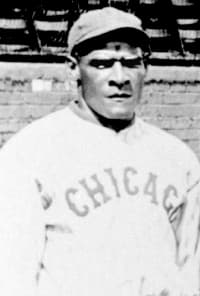
Cristobal Torriente portrait.
Cristóbal Torriente was born in Cienfuegos, Cuba, stood about five feet nine, weighed 190 pounds, batted and threw left-handed, and hit line drives with such violence that C.I. Taylor of the Indianapolis ABCs said, "If I should see Torriente walking up the other side of the street, I would say, 'There walks a ball club.'" He played center field in the Negro Leagues and the Cuban Winter League from 1913 through 1932, batted .341 with 63 home runs and a .939 OPS across 909 documented games, led the Cuban League in triples five times and home runs four times, helped Rube Foster's Chicago American Giants win the first three NNL pennants, and in November 1920, in Havana, hit three home runs in a single game while Babe Ruth went 0 for 3 on the opposing side. The New York Giants scouted him and would have signed him to a major league contract, but they declined because his hair would have prevented him from passing as white. He drank himself to death at 44 in a charity hospital on an island in the East River, and the Special Committee on Negro Leagues elected him to the Hall of Fame in 2006, 68 years later.
Cienfuegos
Torriente was born on November 16, 1893, at 17 Hernan Cortés Street in Cienfuegos, Cuba. His mother was Felipa Torriente of Havana. Details of his father and early family life are sparse, and researchers have speculated about a connection to a nineteenth-century Cienfuegos sugar-processing family, though nothing has been confirmed. One unverified account says he joined the Cuban army at 17 and was assigned to artillery.
Torriente played for the Yara Club at 17 as a left-handed pitcher and part-time outfielder, winning a juvenile district amateur championship. By 19, he moved to the semipro Cienfuegos team and abandoned pitching to become a cleanup hitter. He debuted in the Cuban Winter League in January 1913 with the Habana Reds, batting .265 in 28 games. He played 13 seasons in the Cuban League, batted .352 (among the highest career averages in league history), hit over .300 in 11 of those 13 seasons, won two batting titles, and his teams won six Cuban championships.
Chicago
Torriente played for the Cuban Stars and the All Nations club before joining Rube Foster's Chicago American Giants around 1919. When Torriente arrived, Oscar Charleston was moved from center field to left field to accommodate him. They formed one of the greatest outfield combinations in baseball history.
Torriente won the inaugural NNL batting title in 1920 and helped the American Giants capture the first three NNL pennants from 1920 through 1922. In 1924, he posted a .364 average with a 1.078 OPS. He was a notorious bad-ball hitter who chased pitches out of the zone and still produced elite results.
His temper ran as hot as his bat. On August 23, 1915, he kicked an umpire after being called out stealing third, then fought a player named Crawford with paving stones. Rube Foster personally broke up the brawl. In 1923, he was ejected for throwing dirt on umpire Bert Gholston's "newly creased trousers." Discipline problems followed him throughout his career.
In 1916, Torriente tracked down fellow Cuban star José Méndez so both could be recruited by J.L. Wilkinson's All Nations club. The two are memorialized together on the Monument to Baseballists at Colón Cemetery in Havana.
Havana, November 1920
In October 1920, John McGraw's New York Giants toured Cuba for a series of exhibition games at Almendares Park in Havana. Babe Ruth, paid a reported $2,000 per game, joined the Giants' roster to draw crowds who had never seen the Bambino in person. Torriente played for the Almendares Blues.
The signature game came on November 4. Torriente went 4 for 5 with three home runs, a double, 6 RBI, and 3 runs scored. Ruth went 0 for 3 with two walks and a weak groundout. The score was Almendares 11, Giants 4. Historian Roberto González Echevarría, working from contemporary Havana press accounts, argued that all three home runs were inside-the-park shots at a park whose center field fence sat roughly 600 feet from home plate, though the SABR Games Project reconstruction describes them clearing the wall in left-center, and the question remains unresolved.
Over the full series, Torriente out-hit Ruth .378 to .345 and out-homered him 3 to 2. El Día newspaper wrote, "His hitting will enter Cuban baseball history as one of its most brilliant pages." Frankie Frisch, who played third base during the tour, recalled years later, "He hit a ground ball by me. It dug a hole about a foot deep on its way to left field. In those days Torriente was a hell of a ballplayer."
The Decline
After leaving the American Giants in 1925, Torriente played for the Kansas City Monarchs in 1926, batting .381 before walking away in mid-August following a dispute over a stolen diamond ring. He drifted through the Detroit Stars, Gilkerson's Union Giants, the Atlanta Black Crackers, and the Cleveland Cubs, increasingly used as a pitcher rather than an everyday player. His alcoholism accelerated through the late 1920s and 1930s.
In the mid-1930s, fellow Cubans Martín Dihigo and Rodolfo Fernández found Torriente living in destitution in Chicago and reportedly relocated him to New York. He was too ill to accept an invitation to return to baseball from a former manager. Torriente died penniless of pulmonary tuberculosis on April 11, 1938, at Riverside Hospital on North Brother Island in the East River, at 44, as a ward of the state.
The Grave
The traditional account held that the Batista government exhumed Torriente's remains and repatriated them to Colón Cemetery in Havana, where a Monument to Baseballists features relief busts of Torriente, José Méndez, and Antonio García. Researcher Ralph Carhart discovered, in findings reported by journalist Ryan Whirty in January 2016, that the remains almost certainly never left New York. Torriente was buried in a communal paupers' plot in Section 39 of Calvary Cemetery in Queens, alongside roughly 16 other unidentified dead. Calvary has no record of any exhumation. He may be the only Baseball Hall of Fame inductee buried in an unmarked mass grave.
Cuba inducted him into its Baseball Hall of Fame in 1939 as part of the inaugural class. The Pittsburgh Courier's 1952 all-time Negro League team named him to the outfield alongside Oscar Charleston and Monte Irvin. Bill James ranked him the 67th greatest baseball player of all time in 2001.
Torriente finished with a .341 batting average, 202 doubles, 79 triples, 63 home runs, 709 RBI, and 148 stolen bases across 909 documented games in the Seamheads Negro Leagues Database, which ranks his career WAR third all-time among Negro Leagues players. He batted .311 against major league pitching in 28 documented exhibition games. He pitched occasionally, compiling a 13-7 record. The SABR biography notes that Torriente is remembered "far more for what we don't know, for what has consequently been invented or elaborated, than for what is found in verifiable records or documented events," a line that captures both the tragedy of the incomplete record and the power of the performances that survived it.