Profile
J.L. Wilkinson
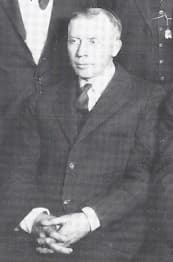
J. L. Wilkinson portrait, 1922.
Photo credit: Unknown photographer via Wikimedia Commons (Public domain)
James Leslie Wilkinson grew up in Iowa, broke his wrist pitching semipro baseball, and spent the next five decades building the most successful franchise in Negro League history as its only white owner. Wilkinson founded the Kansas City Monarchs in 1920 and ran them for 28 years. The Monarchs won ten league pennants and two Negro World Series titles, employed Jackie Robinson before Branch Rickey signed him to the Dodgers, and sent 27 players to the major leagues, more than any other Negro Leagues franchise. Buck O'Neil said, "When I got to know him, I realized I was in the company of a man without prejudice, the first man I had ever known who was like that." The Special Committee on Negro Leagues elected him to the Hall of Fame in 2006.
Iowa
Wilkinson was born on May 14, 1878, in Algona, Iowa, the eldest of six children. His father John J. Wilkinson taught school, served as a superintendent, and later managed an insurance company. Wilkinson pitched for his Omaha high school and then at Highland Park Normal College in Des Moines, where he played semipro ball under the pseudonym "Joe Green" to protect his amateur standing. A broken wrist in 1900 ended his pitching career and redirected him toward managing and promotion.
By 1905, Wilkinson was managing the Hopkins Brothers sporting goods team, booking games across Iowa, Minnesota, and the Dakotas during fairs, carnivals, and festivals. In 1908, he disbanded the men's team and created the Hopkins Brothers Champion Lady Baseball Club, a barnstorming women's team that traveled in a leased Pullman Palace railroad car with six staterooms, a dining room, and a bulldog mascot. Some players wore wigs. At least three men, including a professional wrestler who caught, augmented the roster.
The All Nations
In May 1912, Wilkinson founded the All Nations team in Des Moines, a pioneering multiracial barnstorming baseball club. The roster included Native Americans, black Americans, Japanese, Chinese, Hawaiians, Cubans, and white Americans. They toured in a $25,000 Pullman car, carried a portable canvas fence and fold-up grandstand seating 2,000, pitched tents on the baseball field at night, employed a dance band that played before games, and featured professional wrestlers who entertained crowds between innings. The 1913 team went 119-17.
The All Nations roster included John Donaldson, a left-handed pitcher Wilkinson called "one of the greatest pitchers who ever lived, White or Black." José Méndez, Cristóbal Torriente, and Bullet Joe Rogan all played for the club. The team demonstrated the viability of interracial competition three decades before Jackie Robinson broke the major league color line.
Kansas City
In February 1920, Rube Foster convened a meeting at the Paseo YMCA in Kansas City to establish the Negro National League. Foster was reluctant to include a white owner, but he accepted Wilkinson because of his reputation for integrity and because Wilkinson brought access to stadiums Foster could not secure. Wilkinson was named NNL secretary. A tip from Casey Stengel, a Kansas City native, led Wilkinson to recruit several players from the 25th Infantry Wreckers, an Army baseball team that included Bullet Joe Rogan, Andy Cooper, and Dobie Moore.
The Monarchs won NNL pennants in 1923, 1924, 1925, and 1929. In the 1924 Colored World Series, they defeated the Hilldale club when José Méndez pitched a three-hit shutout in the deciding game despite being told by a doctor he was too ill to play.
In 1929, Wilkinson and his business partner Tom Baird mortgaged everything they owned to secure a $50,000 loan for a portable lighting system. The rig included a 250-horsepower engine, a 100-kilowatt generator, 44 floodlights on telescopic steel poles extending 40 feet above the field, and six Ford trucks to haul it all. Wilkinson said, "What talkies are to movies, lights will be to baseball." The first game under the lights came on April 28, 1930, in Enid, Oklahoma, against Phillips University. Wilkinson recouped his investment within months, and attendance grew from around 5,000 for day games to peaks of 15,000 under the lights. The major leagues played their first night game five years later, on May 24, 1935, at Crosley Field in Cincinnati. The Monarchs toured from the Midwest to Maine, sometimes playing night games in sundown towns where black people were not permitted after dark, protected only by the novelty of the spectacle and the team's reputation.
Satchel and Jackie
In 1938, Satchel Paige was banned from the Negro National League for jumping his contract and suffered the first sore arm of his career in Mexico. Wilkinson was the only executive willing to take a chance on a 32-year-old pitcher with a dead arm. He signed Paige to a barnstorming unit called Satchel Paige's All-Stars, allowing Paige to pitch when able and play first base or coach when not. The arm healed by 1939, and Paige became a leading Monarchs pitcher for the next eight seasons. Paige said, "That's how Mr. Wilkinson was. If you were down and needed a hand, he'd give you one."
Jackie Robinson joined the Monarchs as a shortstop in 1945 after his Army discharge, staying only a few months before Branch Rickey met with him on August 28 and later signed him to the Montreal Royals, the Dodgers' top minor league affiliate. Rickey claimed Robinson had no legitimate contract and paid nothing to the Monarchs. Wilkinson chose not to sue, saying, "Although I feel the Brooklyn club owes us some kind of compensation for Robinson, we will not protest. I am very glad to see Jackie get this chance and I'm sure he'll make good."
The Monarchs won six Negro American League pennants between 1937 and 1946, swept the Homestead Grays in the 1942 Negro World Series, and lost the 1946 Series to the Newark Eagles in seven games. Wilkinson divided the Monarchs' gate share among the players in 1942, an early revenue-sharing gesture.
Wilkie
Wilkinson bought tailored suits for his players and expected them worn around the 18th and Vine district of Kansas City. If an odd number of players stayed in a hotel, Wilkinson shared a room with one of them. In 1923, at 16,000-seat Muehlebach Field, he cut the ropes dividing "white" and "colored" seating sections, integrating the stands. In 1926, he purchased the first of several touring buses with portable kitchens and sleeping accommodations to help his players navigate Jim Crow travel restrictions. He paid for medical care when players needed it and allowed salary advances during the off-season.
His grandson Ed Catron said, "He didn't drink, he didn't cuss, he didn't smoke, he didn't chase women and he never took credit for anything." Larry Lester, the Negro Leagues historian, recalled interviewing former Monarchs about Wilkinson, saying, "I recall the joy on their face and how their eyes would light up when they would talk about him. A complete celebration." Leslie Heaphy of Kent State characterized him as "more of a racial reformer than an opportunist." In 1928, the Monarchs players took out a paid advertisement in The Call that read, "We have a man, the best club owner in the world to work for, who believes in us at all times, who stands for a fair and square deal to all."
Buck O'Neil played for Wilkinson beginning in 1938 and later managed the Monarchs. O'Neil said, "He didn't have a prejudiced bone in him. While Wilkinson could have been lynched just for owning a Black baseball team, he never allowed the ugly racial prejudice of his day to keep him from doing what he loved and believed. J.L. Wilkinson, he looked down on no one and he brought out the best in everyone. I love that man."
Wilkinson sold his remaining interest to Baird in 1948, nearly blind and suffering other ailments. Hank Thompson, Willard Brown, and Elston Howard were among the players who reached the major leagues from the Monarchs during and after his ownership, and the franchise produced 13 future Hall of Famers across its history. Wilkinson died on August 21, 1964, at a nursing home in Kansas City, at 86. Many old Monarchs attended the funeral.