Profile
Travis Jackson
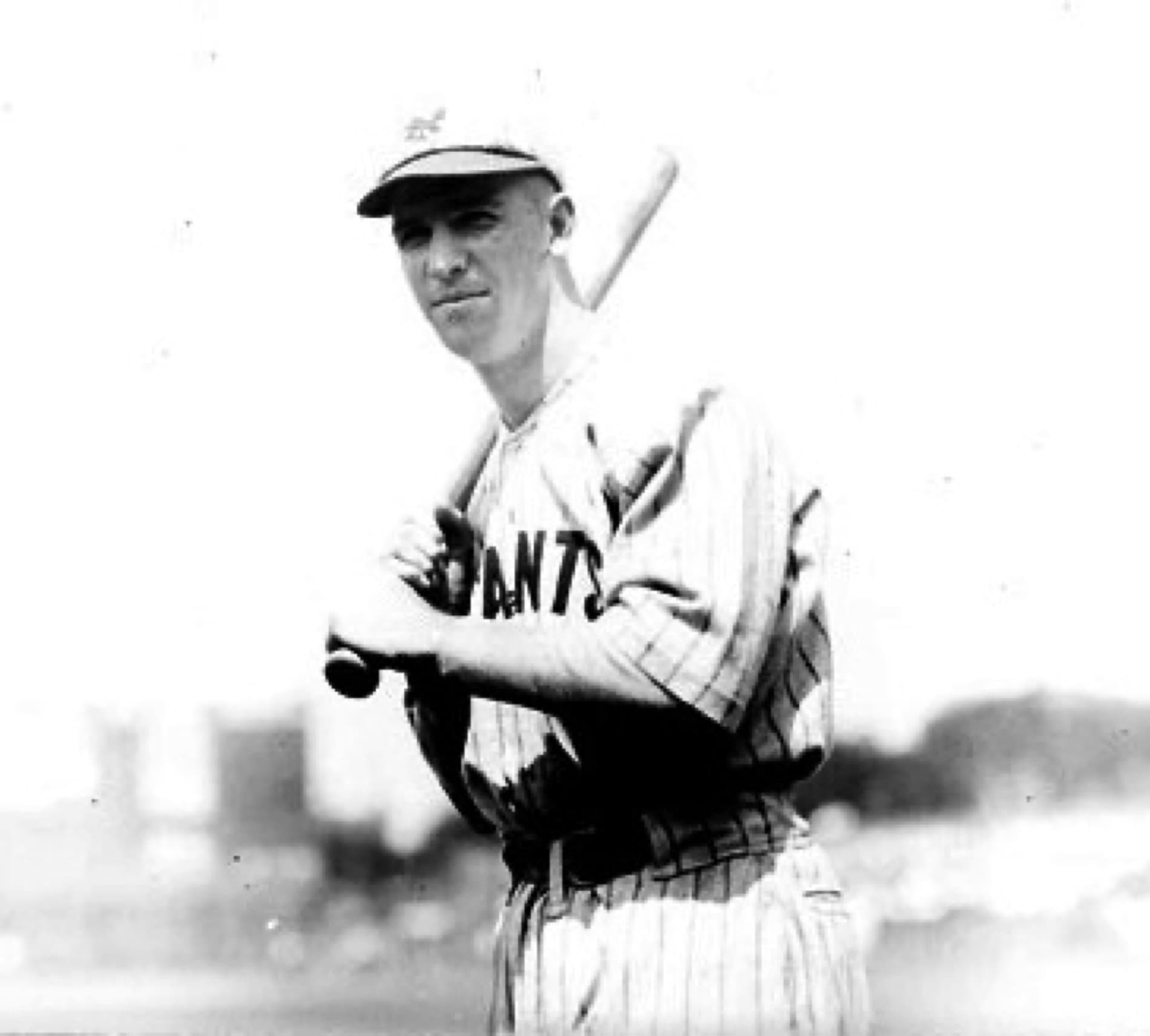
Travis Jackson portrait with New York Giants.
Photo credit: Unknown author via Wikimedia Commons (Public domain)
Travis Calvin Jackson played 15 seasons at shortstop and third base for the New York Giants, all of them under either John McGraw or Bill Terry, and spent most of that time proving himself against the knee injuries that kept trying to end his career. He hit .291 with 135 home runs and an arm that Rogers Hornsby praised by saying, "In all the years I watched him, playing with him and against him, I never saw him make a mistake." The Sporting News voted Jackson the most outstanding shortstop in the National League three consecutive years, from 1927 through 1929. The Veterans Committee elected him to the Hall of Fame in 1982.
Waldo
Jackson was born on November 2, 1903, in Waldo, Arkansas, and was named for William Barrett Travis, the lieutenant colonel who died at the Alamo. His father William was a wholesale grocer, and Jackson was an only child. Jackson attended Ouachita Baptist College in Arkadelphia, where he played baseball and graduated in 1923 with a bachelor's degree. At 14 he met Kid Elberfeld at a Little Rock Travelers game, and Elberfeld invited him into professional baseball and recommended him to McGraw.
Jackson played for Little Rock in the Southern Association in 1921 and 1922, leading the league with 73 errors as a raw shortstop who threw hard but without much accuracy. "I guess I set a world record for errors," Jackson said. "I had a pretty good arm, see, but I didn't have much control." In 1922 Jackson suffered a fractured skull and broken nose in a collision with center fielder Elmer Leifer while chasing a fly ball against the Atlanta Crackers. Leifer suffered a fractured skull and lost the sight in one eye.
The Giants
Jackson made his major league debut on September 27, 1922, at 18, and went 0-for-8 in three late-season games. McGraw brought him back in 1923 and inserted him at shortstop when Dave Bancroft contracted influenza. Jackson hit .275 as the Giants won the pennant. When Bancroft was traded to Boston after the season, Jackson became the everyday shortstop at 20.
Jackson hit .302 with 11 home runs in 1924, including two grand slams. The Giants reached the World Series against Washington, where Jackson committed a key error in Game 7 as the Senators won their only championship (the same game that produced the famous bad hops over Fred Lindstrom's head at third base). Jackson tore cartilage in his right knee in July 1925 and missed a month. The injury became the defining thread of his career. Jackson submitted to surgery on both knees in 1932, battled bone chips and inflammation, and by 1933 was limited to 53 games. He moved permanently to third base in 1935.
Between the injuries Jackson produced stretches of sustained excellence. Jackson hit a career-high 21 home runs in 1929 and batted .339 in 1930 during a season when the entire National League batted .303. He led NL shortstops in fielding percentage twice, in assists four times, and was voted the league's best shortstop three consecutive years by The Sporting News.
The 1933 World Series was Jackson's finest October. In Game 4, with the score tied 1-1 in the 11th inning, Jackson led off with a drag bunt single and scored the winning run, giving the Giants a 3-1 series lead. "I've punched out quite a few hits in my time," Jackson said, "but none that have given me greater gladness than the one I punched out yesterday in the eleventh to start our rally." The Giants won the championship in five games. Casey Stengel called Jackson "the greatest bunter I ever saw."
Jackson's final game was in the 1936 World Series against the Yankees. Terry named him team captain in 1935. Jackson married his childhood friend Mary Blackman in January 1928, and they raised two children in Waldo.
After the Game
Jackson managed the Giants' Jersey City farm club in 1937 but his knees prevented him from continuing as a player-manager. He coached with the Giants under Terry and later under Mel Ott, ending a 27-year association with the franchise in 1948 when Leo Durocher replaced Ott. Jackson then managed in the Braves' minor league system for 14 seasons, from the Southeastern League to the Appalachian League, before retiring in 1960 and returning to Waldo. "I want a rocking chair on the front porch," he said.
Jackson contracted tuberculosis in 1941 and spent several years recovering in a sanitarium. Both his parents died within weeks of each other in 1938. Jackson died of Alzheimer's disease on July 27, 1987, in Waldo, at 83. Terry, who served on the Veterans Committee, advocated for Jackson's election, emphasizing the defensive contributions that voters often overlooked. Hall of Fame president Edward Stack noted that Jackson's induction "included considerable discussion about middle infielders" and considered it a precedent for later defensive shortstops.