Profile
Fred Lindstrom
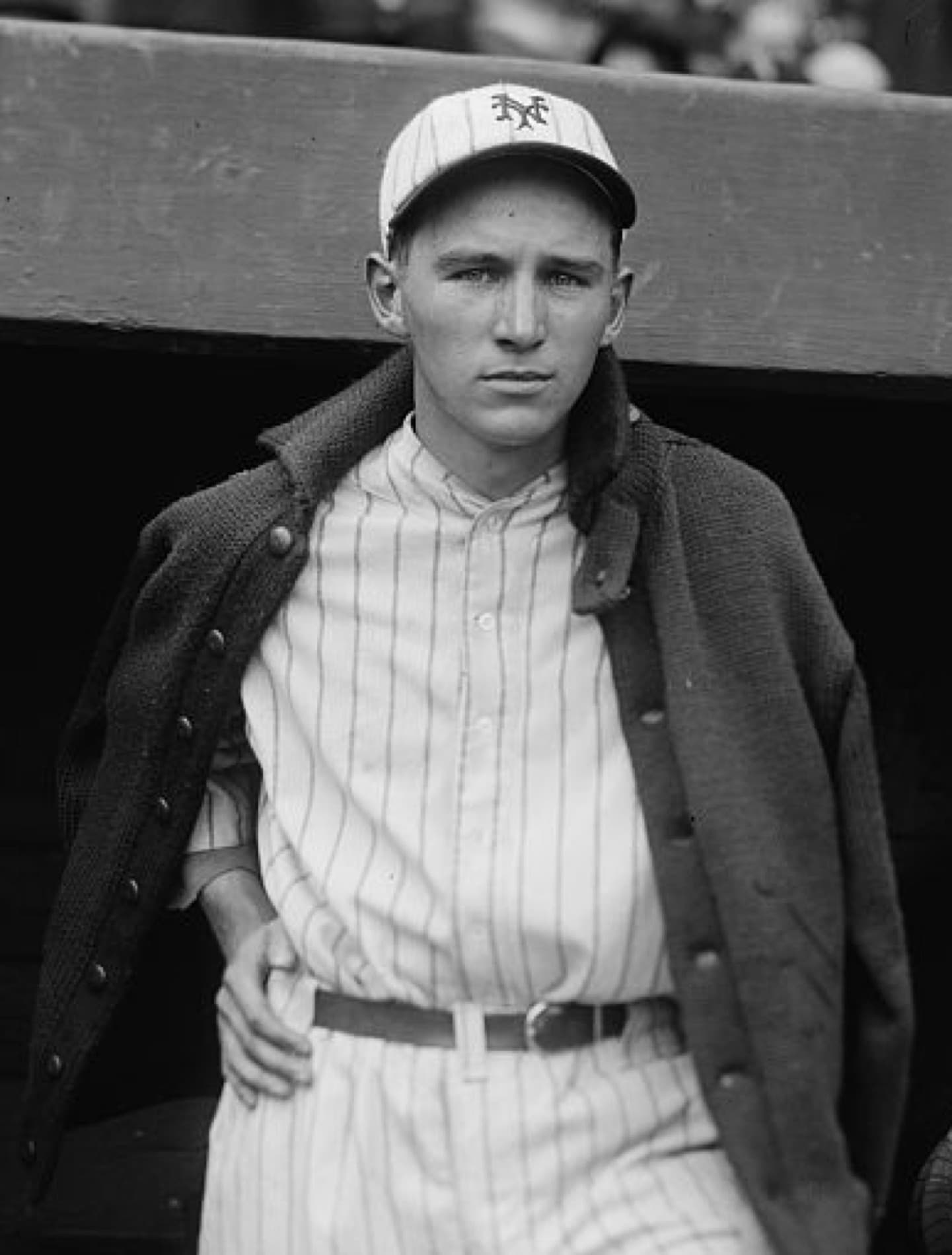
Freddie Lindstrom portrait, 1924.
Photo credit: Unknown author via Wikimedia Commons (Public domain)
Frederick Charles Lindstrom grew up near Comiskey Park idolizing Shoeless Joe Jackson, watched his hero get banned from baseball at 14, signed with the New York Giants at 16, and became the youngest player in World Series history at 18 when two bad-hop grounders bounced over his head in the 12th inning and cost the Giants a championship. He batted .311 over 13 seasons, collected 231 hits in a season twice, and hit .379 in 1930 while finishing only fifth in the batting race because the entire National League was hitting .303. His election to the Hall of Fame in 1976 falls squarely within the Frankie Frisch Veterans Committee controversy, and the debate about whether he belongs has outlasted him.
Chicago
Lindstrom was born on November 21, 1905, on the Southwest Side of Chicago, close enough to Comiskey Park to skip school and watch games. His father Fred was a plumber and his mother Mary Sweeney was of Irish descent. He was devastated by the 1919 Black Sox scandal and the banning of Shoeless Joe Jackson. He attended Loyola Academy in Wilmette after starting at Tilden High School, and a Giants scout watched him hit four extra-base hits in a high school game and signed him for $300 a month.
The Giants assigned him to the Toledo Mud Hens of the American Association in the fall of 1922 at 16, where he hit over .300 in 18 games and played alongside future Giants teammates Travis Jackson and Bill Terry. The Giants purchased his contract on September 18, 1923, and he debuted on April 15, 1924, at 18, replacing the injured Heinie Groh at third base.
The Pebble
Lindstrom batted .253 in 52 games as a rookie, but his October was what followed him. The 1924 World Series between the Giants and Bucky Harris's Washington Senators went seven games, and Lindstrom played well. He batted .333, set a Series record for assists by a third baseman in a single game with seven in Game 2, and collected four hits off Walter Johnson in Game 5. Johnson himself called him "a wonder, easily the brightest star in this series."
Game 7, on October 10 at Griffith Stadium, is what stayed. The Giants led 3-1 in the bottom of the eighth. Harris hit a sharp grounder toward Lindstrom at third base. The ball struck a pebble and took a bad hop over his head into left field, scoring two runs and tying the game. Johnson, who had lost Games 1 and 5, entered in the ninth and held the Giants scoreless through the 12th. In the bottom of the 12th, after catcher Hank Gowdy stepped on his own discarded mask while chasing a foul pop, Earl McNeely hit another grounder toward Lindstrom. The ball again struck a pebble, reportedly the same one, and bounced over his head into left field. Muddy Ruel scored the winning run. Washington won its only World Series championship. Lindstrom was 18, and he remains the youngest player ever to appear in a World Series.
Lindstrom recalled that Giants pitcher Jack Bentley summed it up after the game. "Walter Johnson is such a loveable character," Bentley said, "that the good Lord didn't want to see him get beat again." He understood the play's place in his biography. "It's possible that if it hadn't been for that ball bouncing over my head a lot of people would have forgotten I existed," he told an interviewer. "I didn't do anything but just stand there. It was very easy. Anybody could have done it."
The Polo Grounds
Lindstrom played nine seasons under John McGraw and developed into one of the best hitters in the National League. He batted .302 in 1926, .306 in 1927 as part of an infield with Jackson, Rogers Hornsby, and Terry that Bill James called the decade's best, and .358 with 231 hits in 1928, leading the league in hits and finishing second in the MVP vote behind Jim Bottomley. On June 25, 1928, he collected nine hits in a doubleheader, the first National League player to do so.
His 1930 season was his finest. He batted .379 with 231 hits, 22 home runs, and 106 RBI, becoming the first twentieth-century third baseman to hit 20 or more home runs in a season. He hit .480 with runners in scoring position that year, going 59-for-123, a record identified by SABR Records Committee research. He hit for the cycle on May 8 and put together a 24-game hitting streak. Despite all of it, he finished fifth in the batting race behind Terry (.401), Babe Herman (.393), Chuck Klein (.386), and Lefty O'Doul (.383).
A broken ankle in 1931 forced his move from third base to the outfield. When McGraw resigned on June 3, 1932, with the Giants in last place, club secretary Jim Tierney had told Lindstrom he would be named manager, but the information leaked, McGraw heard about it, and owner Charles Stoneham chose Terry instead. Lindstrom demanded a trade and later called the episode the worst mistake of his life. "If I could have just accepted that setback, it would have worked out in time. But I fouled the whole thing up, forever."
The Giants traded him to the Pittsburgh Pirates, where he played outfield between Lloyd and Paul Waner and batted .310 in 1933, his seventh and final season above .300. He contributed to the Cubs' 1935 pennant, hitting .427 during their 21-game winning streak, and retired in May 1936 after a collision with a Dodgers infielder on a routine pop fly. "I have been in this league 12 years," he said, "and it never happened to me until I put on a Brooklyn uniform."
After the Game
Lindstrom managed in the minor leagues in the early 1940s, winning a Western Association championship with Fort Smith in 1942. He coached baseball at Northwestern University for approximately 14 seasons from 1947 through 1961, then served as postmaster of Evanston, Illinois, from 1961 until 1972. He spent a decade in New Port Richey, Florida, before returning to Chicago.
The Veterans Committee elected him to the Hall of Fame in 1976. The election belongs to the broader pattern of Frisch-era Veterans Committee selections, during which former Giants and Cardinals teammates and contemporaries of Frisch, Terry, and their circle were inducted in a sequence that drew charges of favoritism. Frisch had served on the committee from the late 1960s until his death in 1973, joined by Terry in 1971. The committee elected Jesse Haines, Dave Bancroft, Chick Hafey, Ross Youngs, George Kelly, Jim Bottomley, and Lindstrom between 1970 and 1976, all former Giants or Cardinals teammates. Lindstrom's election was the last in the sequence. Bill James called the pattern "favoritism of the ripest, rottenest and most obvious nature" and ranked Lindstrom as the weakest third baseman in the Hall.
In 13 seasons Lindstrom accumulated 1,747 hits, a .311 batting average, 301 doubles, and seven seasons above .300 while playing strong defense at third base and center field. Arthur Nehf, who pitched alongside him, called him "the cleverest of them all at the plate and the hardest man to fool in the clutch." His son Chuck played one game for the 1958 Chicago White Sox, going 1-for-1 for a career batting average of 1.000.
Lindstrom died on October 4, 1981, at Mercy Hospital in Chicago, at 75, after a long illness. The date happened to fall on the anniversary of the 1924 World Series. Sixty-two family members and friends from Chicago had attended his induction at Cooperstown five years earlier. Heinie Groh, his teammate on the 1924 Giants, had the last word on the pebble. "It wasn't Freddie's fault. It could have happened to anyone. He never had a chance to get the ball."