Profile
Jim Bottomley
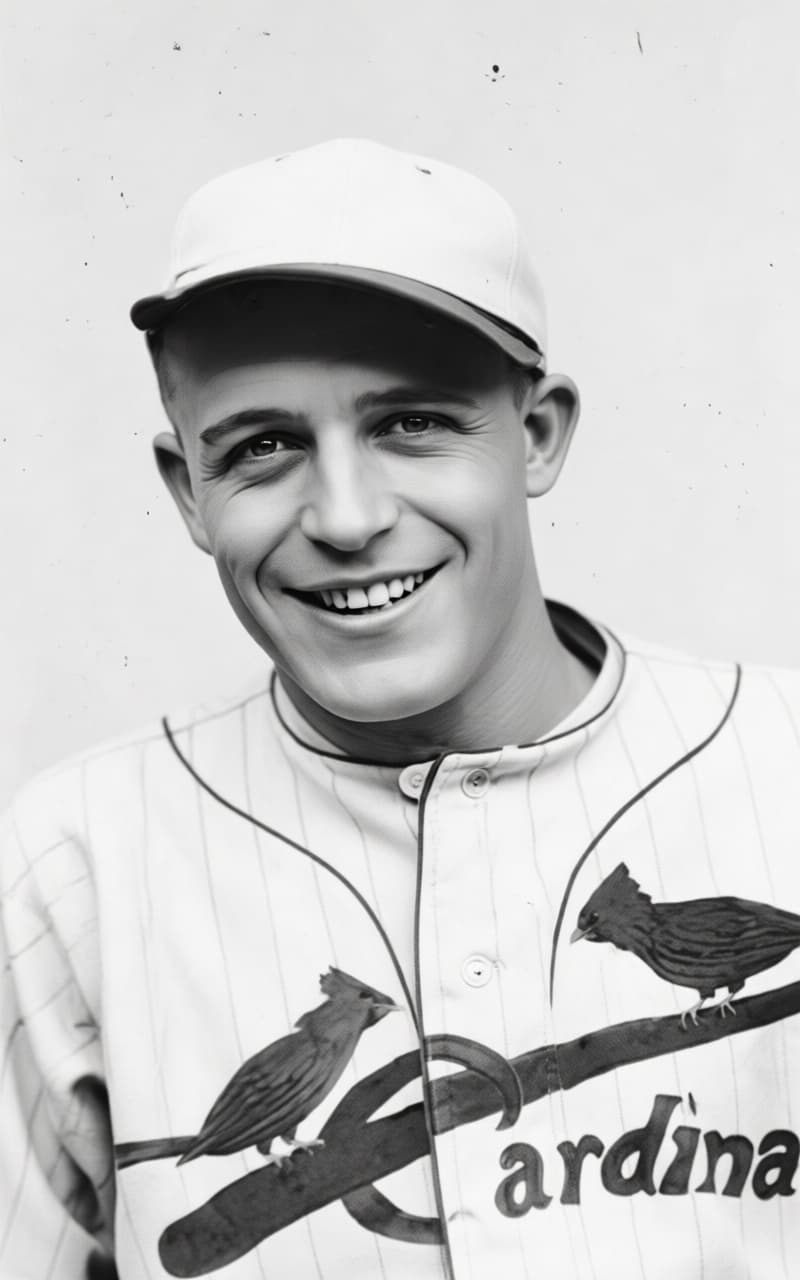
Jim Bottomley portrait.
Photo credit: User-provided image via User-provided image
James Leroy Bottomley drove in 12 runs in a single game, hit .310 over 16 major league seasons, led the National League in home runs, RBI, and triples in his MVP year, and asked for a cow when fans wanted to give him a gift. He got the cow. Her name was Fielder's Choice, and she was a Hereford, paraded before a mid-August crowd at Sportsman's Park before being sent to the farm Bottomley bought with his World Series earnings. They called him "Sunny Jim" because the nickname was accurate. He smiled constantly, wore his cap tilted at a jaunty angle, and played first base with the kind of easy competence that Branch Rickey described in terms bordering on poetry: "His reach from wrist to ankle was sublime."
Nokomis
Bottomley was born on April 23, 1900, in Oglesby, Illinois, and grew up in Nokomis, a small town in the central part of the state. His parents, John and Elizabeth, worked in coal mining and farming. His younger brother Ralph died in a mining accident around 1920. Bottomley quit Nokomis High School at 16 to help support his family and worked as a truck driver, grocery clerk, railroad clerk, and coal miner while playing semipro baseball for $5 a game. A local policeman who knew Rickey connected Bottomley to the Cardinals organization. Scout Charley Barrett evaluated him, and Bottomley signed his first professional contract in late 1919 at 19, earning $150 a month.
He hit .312 at Mitchell in the Class-D South Dakota League in 1920, struggled through a leg injury at Houston in 1921, and broke out at Syracuse in 1922 with a .348 average, 14 home runs, and a .567 slugging percentage. Rickey bought his contract for $15,000.
The Cardinals
Bottomley replaced Jack Fournier at first base on August 18, 1922, and hit .325 in 37 games. In his first full season he batted .371, finishing second in the NL batting race behind Rogers Hornsby's .384. The numbers kept coming. He drove in 100 or more runs in six consecutive seasons from 1924 through 1929, the core of his career and the peak of the Cardinals' run as one of baseball's dominant franchises.
On September 16, 1924, against the Brooklyn Robins, Bottomley went 6-for-6 with two home runs, a double, and three singles, driving in 12 runs. The at-bats produced a bases-loaded single (two RBI), an RBI double, a grand slam, a two-run home run, a two-run single, and a single that drove in another. He broke Wilbert Robinson's 1892 record of 11 RBI in a single game. The record stood for 69 years until Mark Whiten tied it on September 7, 1993.
In 1925, he led the NL with 227 hits while batting .367. In 1926, he led the league with 120 RBI as the Cardinals won the World Series over the Yankees, and Bottomley hit .345 in the Fall Classic. On July 15, 1927, he hit for the cycle.
His finest all-around season came in 1928. He led the National League in home runs (31), RBI (136), triples (20), and total bases (362), while batting .325 with 42 doubles. The combination of 42 doubles, 20 triples, and 31 home runs made him only the second player in history to reach 20 in all three extra-base hit categories. He won the NL MVP award. The Cardinals lost the World Series to the Yankees in a four-game sweep, and Bottomley hit only .214.
The 1931 season produced one of the tightest batting races in baseball history. Chick Hafey won the title at .3489, Bill Terry finished at .3486, and Bottomley came in third at .3482. Less than a single batting-average point separated three future Hall of Famers.
The Cardinals won two more pennants during Bottomley's tenure, in 1930 and 1931, though his production declined from its peak. He hit .304 with 15 home runs in 1930 and .348 with nine home runs in 1931. In four World Series he batted .200 overall, with his .345 in 1926 the high point and a 1-for-22 performance against the Athletics in 1930 the low.
Cincinnati and St. Louis
The Cardinals traded Bottomley to the Reds in December 1932. He never batted above .284 or drove in more than 83 runs in any season in Cincinnati. The Reds traded him to the Browns in March 1936, reuniting him with Rogers Hornsby, who was managing. Bottomley hit .298 that year and announced a mid-season retirement due to a back injury before reversing the decision.
When Hornsby was fired in 1937 with a 25-52 record, the Browns named Bottomley player-manager. He went 21-56 as a manager while hitting .239 as a player. His final game came on September 16, 1937, exactly 13 years after the 12-RBI game. He went 1-for-4 in a loss to the Athletics. He was not retained.
After the Game
Bottomley managed briefly in the minors, broadcast Cardinals and Browns games on the radio for KWK, and raised Hereford cattle on a farm near Bourbon, Missouri, purchased largely with his World Series earnings. He married Elizabeth "Betty" Browner on February 4, 1933. They had no children. He scouted for the Cardinals and Cubs and managed the Pulaski Cubs of the Class-D Appalachian League in 1957 until a heart attack during a June 27 game ended his involvement in organized baseball.
On December 11, 1959, Betty found Bottomley slumped over the steering wheel of his car in a downtown St. Louis parking lot. They had been on a holiday shopping trip. He was 59. He had suffered heart problems since the 1957 attack. He was buried at I.O.O.F. Cemetery in Sullivan, Missouri. A park in Sullivan, Missouri, bears his name, and Nokomis is home to the Bottomley-Ruffing-Schalk Baseball Museum, honoring him alongside fellow natives Red Ruffing and Ray Schalk.
The Veterans Committee
The Veterans Committee elected Bottomley to the Hall of Fame in 1974, 15 years after his death. His election is part of the broader controversy surrounding the committee's work during the late 1960s and 1970s. Frankie Frisch, Bottomley's Cardinals teammate from 1927 through 1932, served on the committee and championed former teammates and contemporaries for induction. Between 1970 and 1976, the committee elected seven players with direct ties to Frisch or Bill Terry: Dave Bancroft, Chick Hafey, Ross Youngs, George Kelly, Jesse Haines, Bottomley, and Freddie Lindstrom. Frisch died on March 12, 1973, before Bottomley's election, but had been the driving force behind the candidacy. The pattern led to charges of cronyism and eventually to reforms that reduced the committee's powers.
Bottomley's case for the Hall is stronger than most of the Frisch-era selections. In 16 seasons he accumulated 1,991 games, 2,313 hits, 219 home runs, 1,422 RBI, and a .310 batting average. He won an MVP, set a single-game RBI record, and drove in 100 or more runs six times. Rickey, who saw him before anyone else did, offered the most direct assessment of his ability: "I noticed one thing that day, and that was that Bottomley could field. By the sinews of Joshua how he could field!"
"I don't have a regret in the world," Bottomley said. "If I had to do it all over again, I wouldn't change a thing. I've loved every minute of it."