Profile
Turkey Stearnes
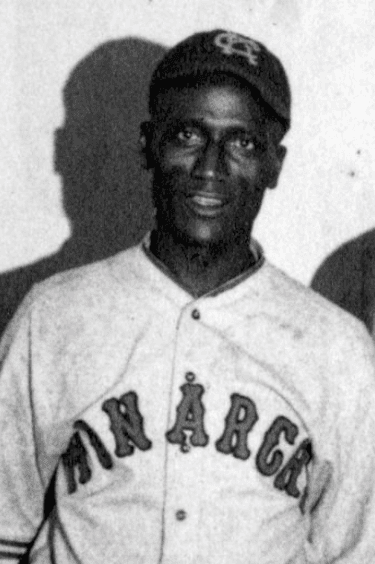
Turkey Stearnes portrait in Monarchs uniform.
Photo credit: Unknown photographer via Wikimedia Commons (Public domain)
Norman Thomas Stearnes lost his father at 15, left school to support his family in Nashville, and spent the next 25 years proving he could hit a baseball as far as any man who ever lived. He played center field in the Negro Leagues from 1920 through 1945, batted .348 across his career, hit 187 home runs (the most in Negro Leagues history, seven more than Mule Suttles), led his league in home runs seven times and triples six times, and carried his bats in a case the way a musician carries violins. Satchel Paige said of him, "Turkey Stearnes was one of the greatest hitters we ever had. He was as good as Josh. He was as good as anybody ever played ball." The Veterans Committee elected him to the Hall of Fame in 2000, 21 years after his death and 55 years after his last game.
Nashville
Stearnes was born on May 8, 1901, in Nashville, Tennessee. His father Will worked as a laborer. His mother Mary worked as a cook, earning $7 a week. When Stearnes was 15 or 16 his father died, and he left school to find work. Nobody explained where the nickname came from to universal satisfaction. Stearnes said it came from having a potbelly as a child. Teammates said it came from his running style, arms flapping like a turkey in full stride. Both stories followed him for the rest of his career.
Stearnes batted and threw from the left side, though he was born right-handed and switched after burning his right arm as a boy. He played for the Nashville White Sox as a teenager, moved to the Montgomery Grey Sox in 1921, and joined the Memphis Red Sox in 1922. The Detroit Stars signed him before the 1923 season, paying him to play for a franchise in Rube Foster's Negro National League.
Detroit
Stearnes arrived in Detroit on March 1, 1923, at 21 years old, and batted .366 with 18 home runs and 15 triples in his first season, leading the league in triples. On May 31 he hit for the cycle against Toledo. He stood six feet tall and weighed 168 pounds, lean and fast, with an unorthodox batting stance that leaned forward and a back foot pointed straight up. He choked up on a light, thin bat and generated power from his shoulders. Jimmy Crutchfield, a teammate, recalled, "Turkey had a batting stance that you'd swear couldn't let anybody hit a baseball at all, but you couldn't criticize him for it when he was hitting everything."
Stearnes played eight seasons in Detroit across two stints. In 1925 he led the Negro National League in hits, triples, home runs, and RBI. In 1928 he slugged 24 home runs in 80 games, a career high. In 1929 he won his first batting title at .390 and led the league in on-base percentage and slugging. Cool Papa Bell said, "That man could hit the ball as far as anybody. He was one of our best all-around players."
The Stars played at Mack Park on the east side of Detroit. The right field fence stood roughly 278 feet from home plate, and Stearnes cleared it regularly. On July 7, 1929, the park burned. The Stars moved to a new field in Hamtramck and won the second-half championship in 1930, then lost the playoff to the St. Louis Stars in seven games, four to three. The Negro National League collapsed during the 1931 season, and Stearnes left Detroit.
Chicago and Kansas City
Stearnes played for the Kansas City Monarchs in 1931, then joined the Chicago American Giants in 1932 and helped them win the Negro Southern League pennant. A second Negro National League formed in 1933, and Stearnes played in the first East-West All-Star Game at Comiskey Park, going 2-for-5 and driving in a run as the West squad won 11-7. He received more votes than any other outfielder for the 1934 game. He earned five All-Star selections between 1933 and 1939.
Stearnes returned briefly to a reconstituted Detroit Stars franchise in 1937, managed them to an 0-3 record, and then rejoined the Chicago American Giants. He signed with the Kansas City Monarchs in 1938 and played three seasons there, helping Kansas City win the 1939 Negro American League pennant. At 38 in 1939 he led the league in runs and home runs. At 39 in 1940 he led in RBI and home runs again. His final professional season came in 1945 with the Toledo Cubs of the United States Negro Baseball League, where he served as field captain at 44.
The Bats
Stearnes talked to his bats. Buck O'Neil recalled walking past Stearnes' hotel room and finding him in his pajamas, speaking to his lumber in the soft, measured tones of a man addressing old friends. He carried them in a special case wherever he traveled. He refused to bunt for his managers on principle, believing that a bat existed to drive the ball and never to deaden it. Teammate Paul Stevens recalled, "Very quiet. About all he would say were 'yes' and 'no.' He was never a fellow to pop off." The bats did the talking.
Stearnes' career numbers, compiled from incomplete Negro Leagues records and updated by researchers over the following decades, place him among the greatest hitters in professional baseball history regardless of league. He batted .348 with a .417 on-base percentage and a .617 slugging percentage across roughly 984 documented games. He hit 187 home runs, 227 doubles, and 112 triples, and stole 129 bases. He led his league in triples six times, tying Sam Crawford for the most such seasons in professional baseball history. When MLB officially integrated Negro Leagues statistics into its historical records in 2024, Stearnes ranked among the top 10 on the all-time lists in both slugging percentage and batting average.
Detroit, Again
Stearnes worked at the Briggs Manufacturing Company during offseasons, painting car bodies, and later at the Ford Rouge plant. After retiring from baseball he spent roughly 27 years working in Detroit's rolling mills. He attended Tigers games at Tiger Stadium, sitting in the bleachers among ordinary fans, watching the sport he helped define from the cheap seats. He never complained about the Hall of Fame, never promoted himself, and never drew attention to his records. His wife Nettie, a schoolteacher and the niece of Negro Leagues veteran Ted "Double Duty" Radcliffe, married him in 1946. They had two daughters, Rosilyn and Joyce.
In December 1971, at 70, Stearnes submitted a Hall of Fame application in his own handwriting. The Hall did not respond during his lifetime. He died on September 4, 1979, in Detroit, at 78.
Nettie Stearnes spent the next 20 years campaigning for her husband's induction. "I prayed every morning for 20 years that this would happen," she said at the ceremony. The Veterans Committee elected Turkey Stearnes to the Hall of Fame in 2000, alongside Sparky Anderson, Carlton Fisk, Tony Perez, and Bid McPhee. In 2007 the Detroit Tigers held Turkey Stearnes Day and installed a permanent plaque at Comerica Park's center field gate. A mural of Stearnes now overlooks Hamtramck Stadium, the field where he played his final Detroit seasons, and where the ball once sailed over the screen and into the streets.