Profile
Jud Wilson
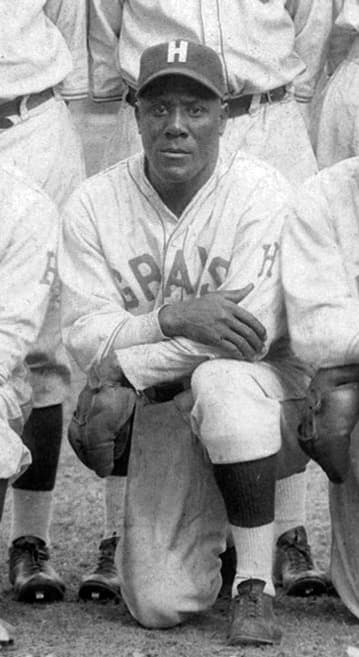
Jud Wilson portrait, 1931.
Photo credit: Unknown photographer via Wikimedia Commons (Public domain)
Ernest Judson Wilson stood five feet eight, weighed 190 pounds, batted left, threw right, crowded the plate so closely that pitchers routinely hit him in the skull, and hit line drives so hard against outfield walls with the Baltimore Black Sox that teammates gave him the nickname "Boojum" for the sound the ball made on impact. He played third base in the Negro Leagues from 1922 through 1945, batted .354 with 100 home runs and a .963 OPS across 1,147 documented games, hit over .400 four times, led the Cuban Winter League in batting twice with averages of .430 and .424, and helped the Homestead Grays win six consecutive NNL pennants from 1940 through 1945. Josh Gibson said Wilson was "the greatest hitter he had ever seen." Satchel Paige named him one of the two toughest hitters he ever faced. Double Duty Radcliffe drew the distinction, saying, "Boojum was a better hitter than Josh. He didn't hit as many home runs, but he hit so many doubles and singles." The Special Committee on Negro Leagues elected him to the Hall of Fame in 2006, 43 years after his death.
Remington
Wilson was born on February 29, 1896, in Remington, Fauquier County, Virginia. His exact birth year is disputed across four different documents, ranging from 1893 to 1899. Wilson acknowledged the confusion himself, saying, "These fellows in our league lie too much about their ages." He was inducted into the U.S. Army on June 29, 1918, and served as a Corporal in Company D, 417th Service Battalion during World War I. After discharge, he settled in the Foggy Bottom neighborhood of Washington, D.C., and played semipro baseball on its sandlots until a scout named Scrappy Brown discovered him and signed him to the Baltimore Black Sox in 1922.
Wilson batted .467 in his first season. He hit .385 with a 24-game hitting streak in 1924. In 1927, he batted .403. In 1928, .399. In 1929, the Black Sox won both halves of the American Negro League split season. Wilson was not just good. He was relentless.
The Meanest Man
Wilson was categorized alongside Chippy Britt, Oscar Charleston, and Vic Harris as one of the "Big Four of the Big Badmen" in Negro Leagues baseball. Jake Stephens, his close friend and roommate, said, "When he saw an umpire, he became a maniac. There was never a meaner, nastier man than Boojum when he put his uniform on."
The stories accumulated across two decades. Wilson held Stephens out of a 16th-story hotel window by one leg after an All-Star Game. He lifted umpire Phil Cockrell off the ground by the skin of his chest and released him only when teammate Crush Holloway brandished a bat. He chased another umpire to center field while waving a bat. He struck umpire Burt Gholston during Game Six of the 1934 NNL championship series and stayed in the game because he threatened to "get him after the game." After another ejection he disputed, three police officers with nightsticks subdued and jailed him. He hit a line drive past the head of Olympic champion Babe Didrikson during an exhibition game, and his manager removed him.
Clint Thomas said, "He'd kill you. He was dangerous. He was never out. The pitcher never throwed a strike. All ball players were scared of him." Ted Page said Wilson "was strong enough to go bear-huntin' with a switch."
The paradox was that teammates who knew him off the field described a different man entirely. Judy Johnson said, "He was good-hearted. He would do anything in the world for you." Ted Page said, "Jud was a kind-hearted individual. He would give you the shirt off his back. The writers made him into a villain." Stephens, the man Wilson had dangled from the 16th floor, said, "He loved me. I could do anything with him." Cool Papa Bell said, "Wilson was one of our great players. He was mean. Ballplayers are like that a whole lot. As soon as they walk out on that field, they want to win. Well, he was that type of guy. Good fellow, but he just got so much heart and soul in this ball game."
The All-Stars
Wilson joined the legendary 1931 Homestead Grays alongside Oscar Charleston, Josh Gibson, Smokey Joe Williams, and Double Duty Radcliffe on a team widely considered one of baseball's greatest. He played briefly for the Pittsburgh Crawfords in 1932 before joining the Philadelphia Stars in 1933, where he served as player-manager from 1937 through 1939 and won the 1934 NNL championship.
Wilson was voted the starting third baseman for the first East-West All-Star Game at Comiskey Park in 1933. In the 1934 All-Star Game, he drove in Cool Papa Bell from second with an infield single for the 1-0 East victory. Across three All-Star appearances, he compiled a .455 batting average.
In 1940, Wilson's two-out, two-run single won the NNL pennant for the Homestead Grays before approximately 30,000 spectators who mobbed him on the field. He remained with the Grays through 1945, contributing to six consecutive NNL championships alongside Josh Gibson, Cool Papa Bell, and Buck Leonard. The 1940-1945 Grays lineup featured four future Hall of Famers playing at the same time.
Cuba
Wilson played six seasons in the Cuban Winter League and compiled a career average of .372. In the winter of 1925-26, he batted .430 to lead the league. In 1927-28, he led again with a .424 average and also led in triples and runs scored. He hit a home run over the right-field wall at Almendares Park, a distance of more than 400 feet that only four other men had cleared, among them Cristóbal Torriente and Oscar Charleston. Cuban fans called him "El Jorocon," which translates to "The Bull." In Puerto Rico in 1944, he batted .404. In the California Winter League, he hit .469 and .385 against major league competition. Vic Harris recalled Wilson facing Lefty Grove in California, saying Wilson took two pitches, then lined the third between Grove's legs into center field. Grove threw his glove down and left the mound.
Wilson also spoke bluntly about integration in a 1939 interview, saying, "It's too big a job for the people who are now trying to put it over. It will have to be a universal movement, and that will never be, because the big-league game, as it is now, is overrun with Southern blood. These fellows would have to stop at the same hotels, eat in the same dining rooms and sleep in the same train compartments with the colored players. There'd be trouble for sure."
Washington
After retiring from baseball following the 1945 season, Wilson worked on a road construction crew in Washington, D.C., building the Whitehurst Freeway. His final employment was as a janitor.
Wilson developed epileptic seizures, possibly triggered by the frequent beanings he absorbed from crowding the plate or by beatings sustained in fights. In his final playing years, Buck Leonard witnessed Wilson drawing small circles in the dirt at third base with his fingers during a Negro World Series game, seemingly unaware of his surroundings. He was hospitalized after the episode. His condition deteriorated after retirement. He required institutionalization and lost most of his memory, though he reportedly brightened when told about his old friend Stephens.
Wilson died of a heart attack on June 24, 1963, in Washington, D.C. He was buried at Arlington National Cemetery, eligible through his World War I service. His only known living relative, great-niece Sha'Ron Taylor, accepted his Hall of Fame award in 2006 after seeing the induction announcement and coming forward. Hall of Fame officials had initially believed Wilson had no living relatives.
Wilson finished with a .354 batting average, 262 doubles, 66 triples, 100 home runs, 891 RBI, and 122 stolen bases across 1,147 documented games in the Seamheads Negro Leagues Database. When MLB integrated Negro Leagues statistics into its official records in May 2024, Wilson's .350 average placed him fifth all-time in combined baseball history. His wife Betty said simply, "Jud was all man. He was a man of few words, but when he said those words, he meant them."