Profile
Kirby Puckett
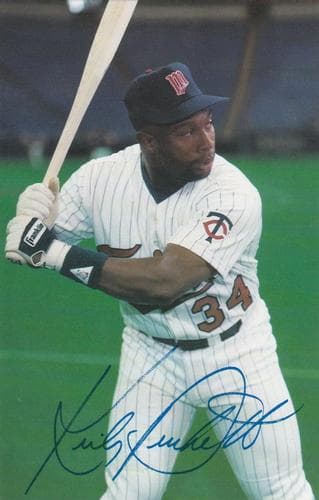
Kirby Puckett portrait in Minnesota Twins uniform, 1987.
Photo credit: Unknown photographer via Wikimedia Commons (Public domain)
Kirby Puckett grew up in the Robert Taylor Homes on Chicago's South Side, the youngest of nine children in a housing project where no baseball fields existed within walking distance. He practiced by throwing a ball against a brick wall with a chalk strike zone, swung bats made of aluminum foil at balls rolled from socks, and received exactly one college scholarship offer after high school. He played all 12 of his major league seasons with the Minnesota Twins, collected 2,304 hits, won six Gold Gloves, made 10 consecutive All-Star teams, and led the Twins to World Series championships in 1987 and 1991. On October 26, 1991, he told his teammates before Game 6 of the World Series, "Jump on my back today. I'll carry us." Then he made a leaping catch above the left-center field fence and hit a home run over the same wall in the 11th inning to win the game. The BBWAA elected him to the Hall of Fame in 2001 with 82.1% of the vote, his first year on the ballot.
Robert Taylor Homes
Puckett was born on March 14, 1960, in Chicago, Illinois. His father William worked for the post office. His mother Catherine raised nine children in a housing project about one mile from Comiskey Park. Puckett attended Calumet High School, played third base, and earned All-America honors despite standing 5'8" and attracting almost no attention from professional scouts. After high school he worked installing carpeting at a Ford plant and took a job as a census taker before either opportunity lasted.
Puckett turned down a scholarship offer from Miami Dade North Junior College and attended Bradley University in Peoria, Illinois, for one year, where he led the team with eight home runs. His father died during that year, and Puckett transferred to Triton Community College in River Grove, Illinois. At Triton he batted .472 with 16 home runs and 42 stolen bases in 69 games and earned Region IV Junior College Player of the Year honors. The Minnesota Twins drafted him third overall in the January 1982 draft and signed him for $20,000 after he turned down an initial offer of $6,000.
The Twins
Puckett tore through the minor leagues. He batted .382 at Elizabethton in the Appalachian League, leading the league in batting average, runs, hits, total bases, and stolen bases. Baseball America named him their Player of the Year. He hit .314 at Visalia in the California League the following season and reached Triple-A Toledo in 1984, where coaches determined he was ready.
Puckett debuted on May 8, 1984, against the California Angels and singled four times after an opening groundout, becoming one of the few 20th-century players to collect four hits in his first major league game. He batted .296 as a rookie with zero home runs in 128 games, slapping singles and running the bases like a man who understood that a center fielder his size proves himself through contact and speed before anything else.
Batting coach Tony Oliva worked with Puckett during the 1985 offseason and taught him to lift the ball. Puckett developed a signature leg kick, and the results showed in 1986 when he hit 31 home runs, won his first Gold Glove, hit for the cycle on August 1 against Oakland, and finished sixth in AL MVP voting. "It was no secret I wasn't going to be tall," Puckett said, "so I figured if I can't be tall, I'll be strong."
The Championships
The 1987 Twins won the World Series over the St. Louis Cardinals in seven games. Puckett batted .357 in the Series, singled to start a rally that scored four runs off John Tudor in Game 6, and collected two hits in Game 7. Minnesota won its first championship since moving from Washington.
Puckett's 1988 season ranks among the finest by any right-handed American League hitter since Joe DiMaggio. He batted .356 with 234 hits and led the majors in hits and total bases. He collected his 1,000th career hit in his first five full seasons, joining Joe Medwick, Paul Waner, and Earle Combs as the only players to reach that milestone so quickly. He finished third in MVP voting. In 1989 he won the AL batting title at .339, his third consecutive season leading the league in hits, matching Rod Carew and Tony Oliva as the only Twins to accomplish it. He signed a contract worth $9 million over three years and briefly became baseball's highest-paid player.
Game 6
The 1991 World Series between the Twins and the Atlanta Braves reached Game 6 on October 26 at the Metrodome with the series tied at three games apiece. Puckett entered hitting .167 for the Series, 3-for-18 through five games.
Puckett tripled in the first inning to drive in Chuck Knoblauch and give Minnesota a 2-0 lead. In the third inning Ron Gant drove a ball toward the Plexiglas fence in left-center field, and Puckett leaped two feet above the wall to haul it in, robbing Gant of extra bases and keeping the Braves scoreless. "I don't care about any of that," Puckett said. "I just want to win."
The game reached the 11th inning tied 3-3. Puckett led off against Charlie Leibrandt, the Atlanta southpaw who struck him out twice in Game 1. On a 2-1 changeup, Puckett drove the ball over the wall in left-center field, the same section of the ballpark where he made the catch eight innings earlier. The 55,155 fans at the Metrodome erupted. Puckett rounded the bases pumping his fist, and the Twins won 4-3 to force Game 7, which Jack Morris won 1-0 in 10 innings. Puckett finished Game 6 with four hits and three RBI.
Ten Straight
Puckett made 10 consecutive All-Star teams from 1986 through 1995. He won the 1993 All-Star Game MVP after homering and hitting an RBI double, the first Twin to earn the honor. In 1992 he finished second in AL MVP voting behind Dennis Eckersley and signed a $30 million contract over five years to stay in Minnesota. In 1994 he collected his 2,000th career hit and broke Carew's franchise record for hits before the players' strike ended the season.
On September 28, 1995, a Dennis Martinez fastball struck Puckett in the face and broke his jaw, ending his season. The following spring, on March 28, 1996, one day after singling off Greg Maddux in an exhibition game, Puckett woke unable to see out of his right eye. Doctors diagnosed central retinal vein occlusion. Three surgeries failed to restore his sight.
Puckett announced his retirement on July 12, 1996, at the Metrodome, at 36. "I came in smiling," he said, "and I'm gonna leave smiling."
After the Game
Puckett served as executive vice president of the Twins and as a national spokesman for the Glaucoma Foundation. His weight, substantial during his playing career, climbed past 300 pounds after retirement. His marriage to Tonya Hudson ended in divorce in 2002 amid allegations of domestic violence. A woman accused him of assault at a suburban Minneapolis restaurant in September 2002, and he was charged with false imprisonment and criminal sexual conduct. A jury acquitted him on all counts in early 2003.
Puckett moved to Scottsdale, Arizona, and became engaged to Jodi Olson in 2005. On March 5, 2006, he suffered a stroke at his home in Phoenix. He died the following day at St. Joseph's Hospital, eight days before his 46th birthday. The cause was cerebral hemorrhage.
Puckett finished with 2,304 hits, 414 doubles, 207 home runs, 1,085 RBI, and a .318 batting average across 1,783 games, all in a Twins uniform. He won six Gold Gloves, six Silver Sluggers, one batting title, and two World Series rings. The Twins retired his number 34 in 1997. Frank Thomas said of him, "He never had a bad day. I don't care how bad things were going on or off the field, Kirby found a way to make you laugh." John Smoltz, who pitched Game 7 of that 1991 Series, said, "When he made the catch and when he hit the home run, his name just seemed to be synonymous with being a superstar."